When Craft Meets Gastronomy: How Steinbeisser and the Houston Center for Contemporary Craft Celebrated 25 Years of Material Innovation

The intersection of fine dining and contemporary craft reached a striking new milestone on October 23, when the Houston Center for Contemporary Craft (HCCC) welcomed 50 guests into its main gallery for an unprecedented evening of experimental gastronomy. Marking its silver anniversary, the HCCC partnered with Steinbeisser—the renowned Amsterdam-based studio celebrated for reimagining everyday objects—to stage a deeply immersive, multi-sensory dining experience. Surrounded by the institution’s ongoing exhibition, A Material Inheritance, attendees gathered at a single, sweeping long table to participate in what would become Steinbeisser’s inaugural Texas event and one of its rare U.S. engagements to date.
This milestone event bridged the gap between visual art, sculptural design, and sustainable gastronomy, reinforcing HCCC’s quarter-century legacy as a vital epicenter for craft and material culture in the American South.
A Genesis of Experimental Gastronomy

Founded in 2009 by Jouw Wijnsma and Martin Kullik, Steinbeisser has spent over a decade challenging conventional notions of how humans interact with utility objects. In 2012, the studio launched its Experimental Gastronomy initiative, a globally traveling project that pairs boundary-pushing chefs with visionary artists. The core philosophy of Steinbeisser rests upon a radical premise: eliminating standard cutlery and dishware entirely, replacing mass-produced items with bespoke, handcrafted artistic pieces that force diners to slow down, reconsider tactility, and establish an intimate connection with the items they use to eat.
For this landmark Houston dinner, Steinbeisser curated a collaborative kitchen featuring culinary talents from two Michelin-starred establishments: Chef Luis Morales of Tatemó in Houston and the team behind Nicosi in San Antonio. True to the studio’s ethos, the resulting menu was entirely plant-based, seasonal, and hyper-local, utilizing organic and biodynamic produce harvested directly from regional farms.

The Chronology of an Immersive Evening
The evening unfolded as a carefully orchestrated sequence of interactive art pieces, courses, and sonic encounters, beginning even before the guests sat down at the communal table.

The proceedings commenced with an amuse-bouche presentation of Bohyun Yoon’s interactive sonic installation, Singing Buoys. Gathered around a specialized water table, guests were handed remote controls to navigate delicate, blown-glass vessels across the liquid surface. Each vessel carried a small bite, and when the floating pieces collided, they chimed like tuned bells, immediately establishing a playful, tactile tone for the night.
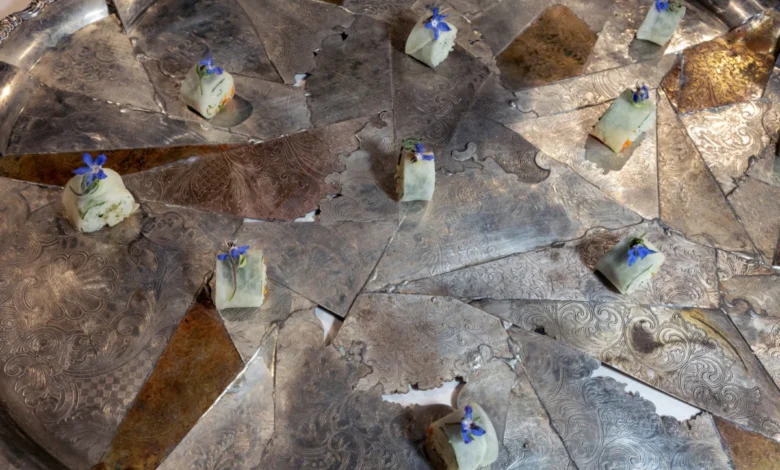
As guests took their seats inside the gallery—framed by large, suspended sculptural installations—the culinary program commenced with the first course provided by Tatemó. Diners were served nixtamalized squash, Koshihikari rice, kosho, and vibrant carrots. The dish was presented on Jaydan Moore’s Sustenance #1, a sculptural platter intricately assembled from salvaged, antique silver-plated servingware. The juxtaposition of historic, tarnished metal with contemporary, hyper-refined plant-based cuisine immediately anchored the meal in themes of memory and material transformation.

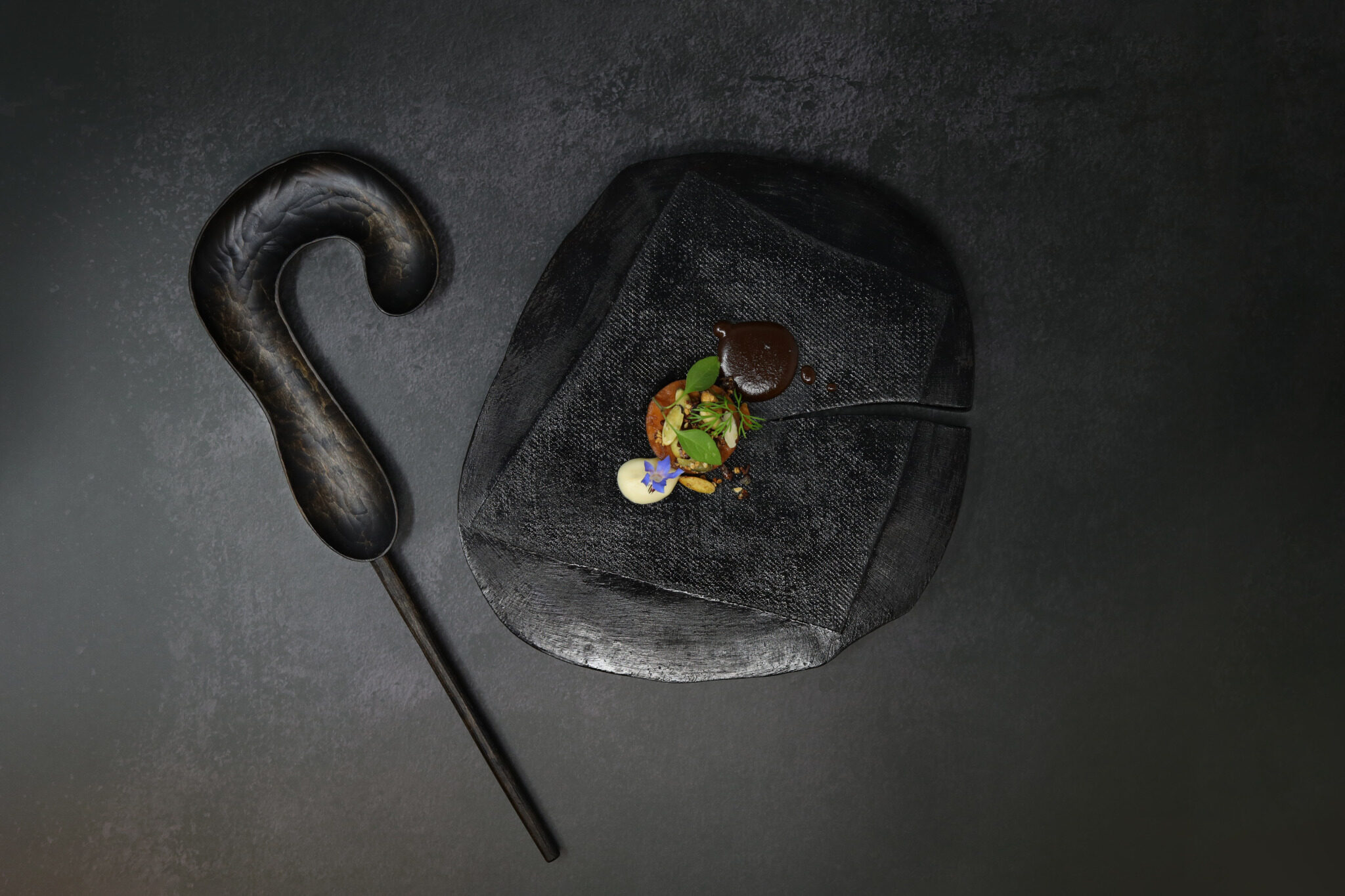
The second course transitioned to the culinary artistry of Nicosi’s Jorge Luis Hernández and Ben Hjelm, who prepared a Kudzumochi Tamal featuring pumpkin juice, mushroom, masa foam, hoja santa, and delicate flecks of gold leaf. This course arrived on Adam Knoche’s Exploding Plate—a dramatic piece made from crushed basalt clay pressed and fired at a staggering 2,250 degrees Fahrenheit to induce intentional fracturing. Accompanying the plate were Knoche’s complementary carafe and sauce bowl, which incorporated foraged Texas clay and Galveston seashells.
To consume the dish, guests utilized Lisa Marcolongo’s Utensilia spoons. Crafted by the Italian artist from trees felled by severe storms in Milan, the spoons featured organic wooden bowls fitted with electroformed recycled copper handles, marrying urban ecology with bespoke design.

The third and final savory course, again courtesy of Tatemó, featured smoked sweet potato, savory granola, and a dual presentation of artisanal moles. The dish was served on Seok-hyeon Yoon’s Zwaart Plate, finished in ottchil—a traditional Korean lacquer made from tree sap that has been utilized by monastic artisans for approximately two millennia. This was paired with Kyungwon Hwang’s lacquered maple spoons. Nearby, Heejoo Kim’s paper-and-lacquer Gokkal Cups were set against the backdrop of Mark Reddy’s towering, hand-carved Standing Spoons, creating a forest-like tableau of monumental wooden utensils across the table.
Curatorial Vision and Material Philosophy

The entire collection of tableware used during the evening was curated by Sarah Darro, who selected 13 international and domestic artists to contribute to the event. In her curatorial statement, Darro noted that the collaborative works successfully transformed the dining table into "a site of experimentation, sensory discovery, and material invention." By employing techniques ranging from high-heat ceramic firing and woodcarving to glassblowing and metal electroforming, the participating artists elevated familiar utensils into what Darro termed "sculptural provocations."
The roster of participating artists showcased a diverse, global cross-section of contemporary craft talent:

- Kaye Winwood and Nuala Clooney (Glass, USA)
- Kyungwon Hwang (Wood, South Korea)
- Heejoo Kim (Jewelry, South Korea)
- Adam Knoche (Ceramics, USA)
- Molly Koehn (Fiber, USA)
- Namgwon Lyu (Craft, South Korea)
- Lisa Marcolongo (Contemporary Jewelry, Italy)
- Edward Lane McCartney (Jewelry and Multimedia, USA)
- Jaydan Moore (Metalsmithing and Printmaking, USA)
- Jakob Niemann (Wood, Sweden)
- Mark Reddy (Contemporary Art and Craft, UK)
- Bohyun Yoon (Glass, USA)
- Seok-hyeon Yoon (Design, Netherlands and South Korea)
Following the conclusion of the dinner, guests were given the opportunity to purchase the bespoke pieces, extending a tradition that Steinbeisser has maintained through its online store since 2016. This commercial aspect ensures that the boundaries established during these one-night-only dining performances continue to resonate in domestic settings.
Context, Background, and Institutional Legacy

The timing of Steinbeisser’s collaboration with the Houston Center for Contemporary Craft was deeply symbolic. Beyond marking the organization’s 25th anniversary, the dinner served as a high-profile fundraising gala, supporting HCCC’s ongoing mission to advance education, exhibition, and public appreciation of craft.
The event’s integration within the A Material Inheritance exhibition—which explores silver as both a physical medium and cultural metaphor—underscored the institution’s commitment to examining historical roots through a modern lens. Silver, historically prized for its reflective qualities, served as an apt metaphor for an evening that reflected simultaneously on the HCCC’s quarter-century history and the broader evolution of the craft movement.

Industry analysts and cultural critics have increasingly pointed to experimental gastronomy as a vital frontier for the craft sector. By removing art from the passive environment of display cases and placing it directly into the hands of users during a fundamental human ritual—eating—institutions like HCCC and creators like Steinbeisser breathe new life into traditional mediums. Whether utilizing storm-felled timber from European municipal parks, reclaimed antique silverware, or foraged regional clay mixed with coastal shells, these collaborations demonstrate that sustainability and high artistry are entirely compatible.
Broader Impact and Implications for the Field of Craft

As the Houston Center for Contemporary Craft looks toward its next quarter-century, events like the Steinbeisser experimental dinner signal a shift in how cultural institutions engage their communities. No longer confined to quiet gallery walkthroughs, contemporary craft is increasingly presented as an active, experiential, and participatory discipline.
By handing diners a fractured ceramic plate, a monumental wooden spoon, or a sound-producing glass vessel, HCCC made a compelling case for the relevance of craft in the 21st century. The underlying message of the evening was clear: craft is not merely an artifact of the past to be preserved behind glass, but a living, dynamic medium meant to be held, utilized, shared, and ultimately integrated into the daily rhythm of human life.