Price Latimer and the Evolution of Sustainable Aesthetics through the Lens of Alkemis Paint


Price Latimer, a multidisciplinary creative and the co-founder of Alkemis Paint, represents a modern intersection of fine art, entrepreneurial strategy, and environmental advocacy. Her career trajectory—stretching from the Texas Panhandle to the high-stakes design markets of Los Angeles and New York—culminated in 2021 with the launch of Alkemis Paint alongside co-founder Maya Crowne. The company distinguishes itself in a crowded architectural finishes market by utilizing a proprietary formula centered on clear quartz and natural minerals, effectively removing the reliance on petrochemical-based binders common in the industry. Latimer’s journey is not merely one of business development but is a reflection of a life-long immersion in the arts, ranging from neo-conceptualism to large-scale land art and avant-garde performance.
A Foundational Exposure to the Arts
The origins of Latimer’s aesthetic sensibility can be traced to her upbringing in Amarillo, Texas. Residing in close proximity to the Amarillo Museum of Art, she was exposed from an early age to a permanent collection featuring heavyweights of American modernism and minimalism, including Georgia O’Keeffe, Larry Bell, and Louise Nevelson. This early exposure provided a framework for understanding space, light, and materiality—themes that would later define her professional endeavors.
Latimer pursued a formal education at the Rhode Island School of Design (RISD), an institution renowned for its rigorous approach to design thinking. After obtaining her bachelor’s degree, she relocated to New York City, where she entered the orbit of Peter Halley, a central figure in the neo-conceptualist movement. Working for Halley and contributing to his publication, Index magazine, Latimer was positioned at the vanguard of 1990s and early 2000s cultural discourse. This period was instrumental in refining her ability to blend editorial vision with visual art, a skill set she eventually transitioned to the West Coast.

Professional Diversification and the Founding of Alkemis Paint
Upon moving to Los Angeles, Latimer’s career took a turn toward the commercial and experiential. She navigated the local gallery scene before pivoting into the hospitality and luxury furniture sectors. Her role as Chief Creative Officer for a co-founded restaurant venture and her subsequent tenure at the Italian furniture manufacturer Kartell allowed her to apply her artistic background to spatial design. At Kartell, she acted as a consultant for architects and interior designers, managing the furnishing of diverse environments from corporate offices to high-end hotels.
However, it was the realization of a gap in the sustainable design market that led to the creation of Alkemis Paint in 2021. The global paint and coatings market has historically been dominated by products containing high levels of Volatile Organic Compounds (VOCs) and petrochemical derivatives. While "Low-VOC" options became a standard in the 2010s, Latimer and Crowne sought to go further by creating a 100% natural, mineral-based alternative. By using clear quartz—a mineral known for its durability and light-refractive properties—Alkemis Paint offers a finish that is functionally superior to traditional acrylic paints while remaining ecologically inert.

Chronology of Artistic and Geographic Influences
Latimer’s worldview is significantly shaped by five specific cultural and environmental touchstones, which she recently detailed as part of a broader discussion on her creative process. These influences provide a roadmap for the "Alkemis" philosophy:
- The Avant-Garde Legacy of Leigh Bowery: Latimer cites the late Australian performance artist Leigh Bowery as a primary inspiration. Bowery, a fixture of 1980s London nightlife, used his own body as a canvas for radical sculptural experiments. For Latimer, Bowery represents the ultimate blurring of lines between art and life. His influence is visible in her willingness to push the boundaries of color and texture within the home environment.
- The Geological Vibrancy of Palo Duro Canyon: Often referred to as the "Grand Canyon of Texas," Palo Duro Canyon’s oxidized red and lavender siltstone layers served as the direct inspiration for specific Alkemis Paint pigments. The canyon’s history, stretching back 15,000 years to the Comanches and later captured in the paintings of Georgia O’Keeffe, serves as a reminder of the inherent relationship between the earth’s minerals and the human desire to document color.
- The Precision of Land Art: In the high desert of New Mexico, Walter de Maria’s The Lightning Field (1977) remains a seminal site for Latimer. Commissioned by the Dia Art Foundation, the work consists of 400 stainless steel poles arranged in a precise grid. Latimer’s experience at the site—characterized by a profound sense of scale and silence—informs the minimalist and intentional nature of her design projects.
- Marine Conservation and Scuba Diving: A diver since her early teens, Latimer’s obsession with the "underwater kingdom" has fueled the environmental mission of her company. The degradation of coral reefs due to chemical runoff is a primary concern; consequently, Alkemis Paint is marketed as a "petrochemical-free" alternative designed to prevent harmful microplastics and toxins from entering waterways.
- The Conceptual Philosophy of Yoko Ono: Latimer points to Ono’s Cleaning Piece III from the book Acorn as a guiding mantra. The work encourages practitioners to avoid negativity and observe the resulting changes in life. This focus on compassion and empathy translates into a business model that prioritizes the health of the end-user and the artisan.
Strategic Collaborations and Market Impact
Since its inception, Alkemis Paint has secured high-profile collaborations that validate its standing in both the fine art and design communities. These partnerships demonstrate the brand’s versatility and its ability to enhance curatorial narratives through color.

- The RISD Museum: Latimer returned to her alma mater to collaborate on the paint palette for the Liz Collins: Motherlode exhibition. Collins, a queer feminist artist, is known for her radical use of fiber and pattern. The use of Alkemis Paint in this context highlighted the synergy between sustainable materials and avant-garde textile art.
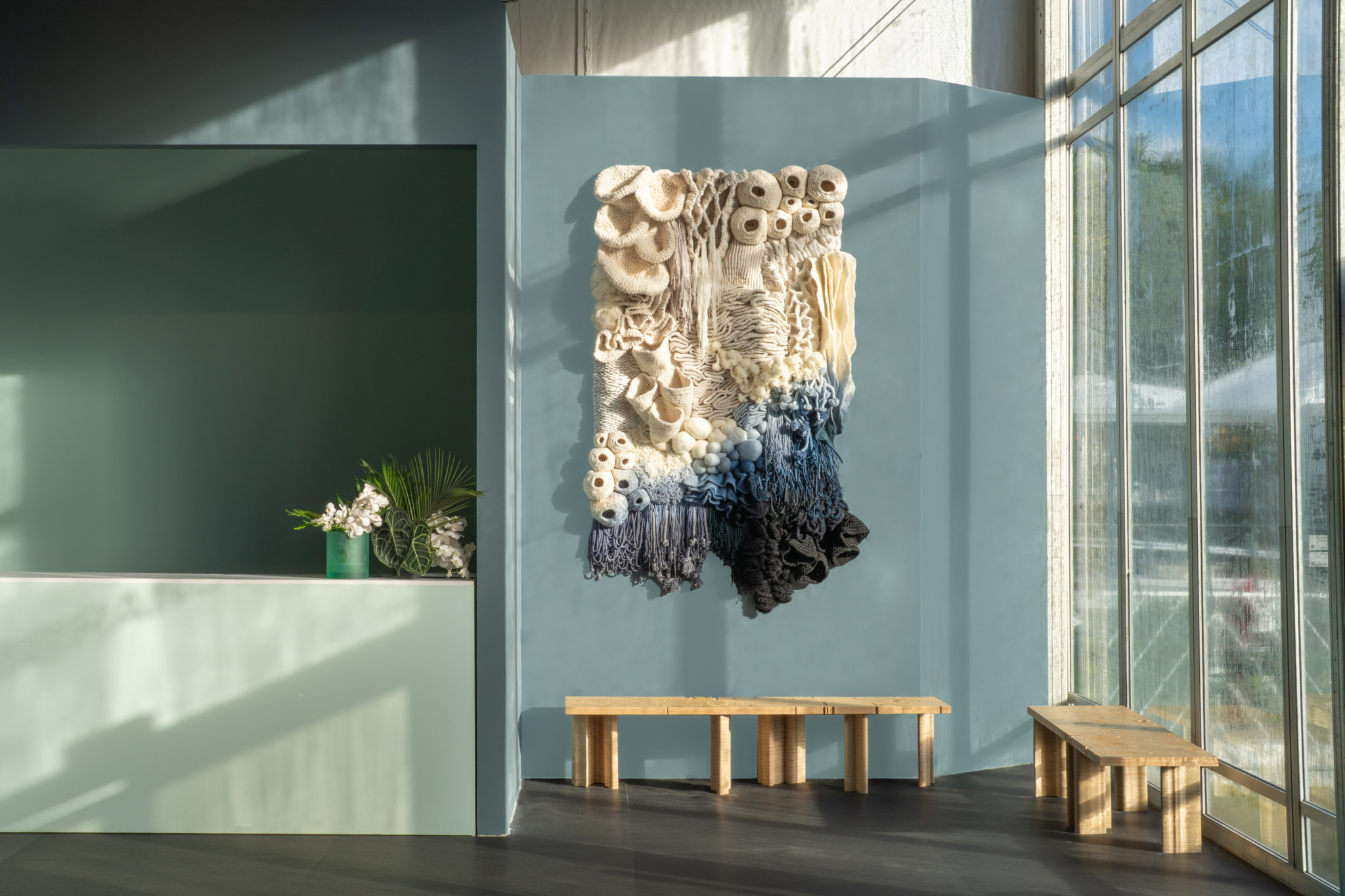
- Design Miami: For three consecutive years, Alkemis has been the paint partner for Design Miami, one of the world’s premier art and design fairs. By developing custom palettes that harmonize with the fair’s curatorial themes, Latimer has successfully positioned a hardware-category product (paint) as an essential component of the luxury art market.
- Objects USA: In a collaboration with R & Company, Alkemis Paint was used to create complex gradient murals for the Objects USA exhibition. This project, executed by muralist Nick Kuszyk, challenged the "white box" gallery tradition, using vibrant visual innuendo to guide visitors through a chronological history of American craft and design.
Supporting Data: The Shift Toward Sustainable Interiors
The rise of companies like Alkemis Paint is supported by a significant shift in consumer behavior and regulatory standards. According to market research, the global green coatings market is projected to grow at a CAGR of over 5% through 2030, driven by increasing awareness of "Sick Building Syndrome" and the environmental impact of synthetic polymers.
Traditional paints are a major source of microplastics; it is estimated that paint accounts for as much as 58% of all microplastics entering the world’s oceans. By utilizing mineral binders instead of plastic ones, Latimer’s venture addresses a critical environmental loophole. Furthermore, the use of quartz and mineral pigments offers a longevity that traditional paints lack, as mineral colors do not fade under UV exposure in the same way that synthetic dyes do.

Broader Implications for the Design Industry
Price Latimer’s work suggests a future where the distinction between "industrial product" and "artistic medium" continues to dissolve. Her ability to draw from the historical depth of Palo Duro Canyon or the conceptual rigor of Walter de Maria allows her to market a product that is as much about a "lifestyle of consciousness" as it is about home renovation.
The success of Alkemis Paint also signals a broader trend in the interior design industry: the move toward "biophilic" and "well-being" focused spaces. As consumers spend more time indoors, the demand for materials that do not off-gas harmful chemicals has transitioned from a niche preference to a mainstream requirement. Latimer’s background in high-concept art ensures that this transition to health-conscious materials does not come at the expense of visual sophistication.

Through her ongoing work with photographers like Joe Kramm and artists like Roberto Lugo—a ceramicist whose work addresses social justice—Latimer continues to embed her brand within a network of creators who prioritize narrative and ethics. As Alkemis Paint expands its reach, it stands as a testament to the idea that the most effective design solutions are often those rooted in a deep appreciation for the natural world and the artistic movements that seek to protect it.