The Silent Siege: How Sophisticated Typosquatting Campaigns Are Disrupting the Luxury Jewelry E-commerce Market

The first indication of a systemic security breach for many luxury jewelry retailers does not arrive in the form of a customer complaint or a sudden collapse in sales; rather, it appears as a cryptic, granular entry in the Google Search Console. Behind the scenes of the thriving digital marketplace for high-end pre-owned goods, a sophisticated, patient, and highly technical form of digital sabotage is unfolding. This campaign, which has been intensifying over the past eighteen months, leverages a combination of domain typosquatting and negative Search Engine Optimization (SEO) to erode the organic visibility of established luxury brands. Unlike traditional cyberattacks that focus on credit card theft or credential harvesting, this new threat landscape is designed to manipulate the very algorithms that dictate search engine rankings, effectively forcing legitimate retailers into a state of involuntary decline.
The Mechanics of the Modern Digital Sabotage
At its core, the operation is a sophisticated subversion of search engine trust signals. Typosquatting—traditionally understood as the registration of domain names that mimic established brands through minor misspellings—has historically been the domain of fraudsters looking to deceive consumers. However, the current iteration observed in the luxury jewelry sector represents a departure from this model. Attackers are not creating functional, deceptive storefronts to capture data; instead, they are registering domain variations that remain dormant, empty, or parked.
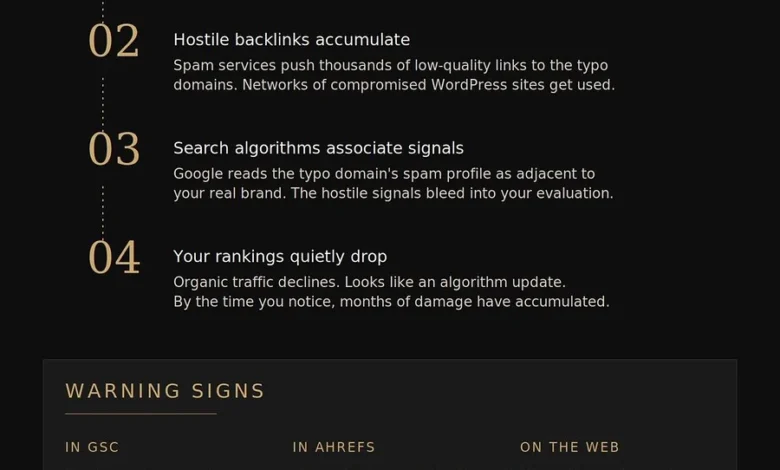
The damage is inflicted through a massive, coordinated injection of low-quality, spam-flagged backlinks directed at these empty typo-domains. By generating thousands of links from illegitimate sources to a domain that is visually and textually similar to a legitimate brand, the attackers create a "hostile backlink profile." The objective is to confuse search engine crawlers. As these algorithms analyze the broader digital footprint of a brand, they inadvertently associate the negative signals of the typo-domain with the legitimate business. Consequently, the authentic retailer sees a gradual, baffling erosion of its search engine rankings, as the authority of its domain is undermined by this artificial association with spam.
A Timeline of Escalation
Industry analysts and retailers began noticing a marked increase in these activities in late 2024. While isolated incidents of spam are common in competitive digital markets, the intensity of this campaign suggests a centralized, automated infrastructure. Data logs from various impacted firms show a rapid, weeks-long construction of these link-spam networks, utilizing compromised WordPress sites to inject commercial anchor text that targets high-value keywords.
By the first quarter of 2025, the pattern became undeniable. The attackers were found to be using aged-domain marketplaces—platforms where expired, previously reputable domains are auctioned—to recycle established, high-authority profiles. By mapping these profiles onto their typosquatted variants, the attackers effectively accelerated the speed at which the "poisoned" signal reached the target brand. This is not a sporadic attack; it is a calculated, persistent assault on the digital infrastructure of the luxury goods market.
Why Luxury Jewelry is the Primary Target
The targeting of the jewelry sector is not accidental; it is driven by the unique economics and technical vulnerabilities inherent in the industry. First, the high average order value of luxury jewelry means that even a marginal decline in organic search traffic results in substantial revenue loss. When a single transaction can reach five figures, a drop in visibility for key product terms translates into a direct and compounding financial deficit.
Second, the keyword landscape for luxury jewelry is highly competitive but hyper-specific. Consumers searching for terms such as "pre-owned Cartier Love bracelet" or "authenticated Van Cleef Alhambra" possess clear, high-intent purchase motivation. Because the number of authoritative, trusted retailers ranking for these specific terms is limited, even a minor downward shift in Search Engine Results Page (SERP) positioning can force a brand out of the "money zone"—the top three results that command the vast majority of clicks.
Finally, the industry’s reliance on trust and provenance creates a unique vulnerability. Luxury retailers distinguish themselves through detailed authentication content, provenance documentation, and high-quality descriptions. This content-rich strategy is precisely what search engines reward. By attacking the domain authority of these retailers, the perpetrators are effectively nullifying the years of effort spent building that institutional trust.
Diagnostic Indicators for Retailers
For the average independent jeweler or boutique operator, the symptoms are often misinterpreted as general algorithm volatility or routine spam. However, a systematic review of data can reveal the presence of an active campaign.
In Google Search Console, administrators should monitor for sudden, unexplained spikes in referring domains, particularly those originating from regions where the brand does not conduct business. Additionally, the presence of indexed pages containing brand names paired with unrelated commercial terms is a critical warning sign.
Backlink monitoring tools, such as Ahrefs or Semrush, provide more granular data. Retailers should look for:
- An influx of links classified as "spam" or "low-quality" by automated detection systems.
- Inbound links from domains that feature excessive outbound link counts—a hallmark of compromised, automated sites.
- Anchor text that combines the brand name with commercial keywords from unrelated industries, such as gambling or adult content, which are commonly used in spam networks.
A Layered Defensive Strategy
Defending against this form of negative SEO requires a multi-faceted approach, as there is no single "kill switch" for the attack.
1. Strategic Disavowal: The most immediate defense is the rigorous maintenance of a Google Search Console disavow file. While this does not remove the offending links, it formally instructs Google’s algorithms to ignore them when calculating the reputation of the target domain. For firms under active assault, this process must be iterative, often requiring weekly or monthly updates as new, malicious domains are identified.
2. Proactive Reporting: Retailers should utilize the official Google spam reporting channels to flag typosquat domains. While not an immediate remedy, these reports contribute to the platform’s broader threat intelligence. When filing, it is crucial to categorize the activity accurately—usually as "paid links" or "link schemes"—to ensure the report is routed correctly within the spam-detection department.
3. Legal Recourse and Trademark Enforcement: If the activity constitutes a clear violation of intellectual property, legal action via the Uniform Domain-Name Dispute-Resolution Policy (UDRP) or the Anticybersquatting Consumer Protection Act (ACPA) may be necessary. UDRP is generally more cost-effective and faster for transferring or canceling domain names, provided the retailer has established trademark rights. For more severe cases, the ACPA allows for statutory damages, which can serve as a deterrent to repeat offenders. However, both paths require strong documentation, including WHOIS data, timelines of attack patterns, and evidence of lost organic traffic.
Pitfalls in Defensive Measures
The stress of an ongoing attack often leads business owners to make tactical errors that exacerbate the situation. A common mistake is attempting to "defensively register" the typosquat domains. Purchasing these domains is counterproductive because the buyer inherits the entire backlink profile—including the hostile, spam-heavy history. The brand effectively becomes the owner of a poisoned asset.
Furthermore, engaging directly with the attackers—whether through public denouncement or private communication—is strongly discouraged. These actors rely on the monetization of their infrastructure; public confrontations often signal to the attacker that the victim is engaged and vulnerable, which can lead to more aggressive targeting.
Broader Implications and Future Outlook
The rise of typosquatting paired with negative SEO represents a maturing of the "dark side" of digital marketing. As search engines continue to refine their AI-driven ranking systems, the reliance on signals like "brand association" and "link velocity" will likely remain. This creates a permanent, structural vulnerability for any brand that relies on organic discovery.
For the luxury jewelry sector, this situation underscores the necessity of treating digital security as a core business function rather than an IT afterthought. The industry’s shift toward e-commerce necessitates a higher standard of vigilance. The most effective defense remains industry-wide awareness and the sharing of threat intelligence. When jewelers communicate about the patterns they observe, they diminish the attacker’s ability to operate in the shadows.
The threat is not going to disappear; rather, it will continue to evolve in complexity as attackers find new ways to exploit the architectural trust mechanisms of the web. The burden of defense now rests on the brands themselves to monitor, document, and proactively manage their digital reputations with the same precision they apply to their physical inventory. Knowledge of the attack is the first and most critical step toward mitigation; the work of the coming years will be to ensure that this awareness becomes a standard pillar of digital business operations.