The Silent Predation of Luxury Jewelry E-Commerce Through Typosquatting and Negative SEO

The first indication of a sophisticated digital assault often arrives not with a system crash or a ransom note, but as a subtle anomaly in a data report. For Opulent Jewelers, a prominent retailer in the luxury pre-owned market, the warning was a quiet line in the Google Search Console disavow report indicating that referring domains had surged by several hundred within a single week. These were not jewelry-related sites, nor were they legitimate partners; they were an array of unknown domains appearing in a coordinated pattern, all linking to luxury retailers with a singular, hostile intent.
This phenomenon represents a shifting threat landscape for the jewelry e-commerce sector, moving away from traditional phishing and credit card fraud toward a more patient and technically complex form of sabotage. This strategy, which combines typosquatting with negative Search Engine Optimization (SEO), has been quietly targeting high-end brands for approximately eighteen months, often remaining undetected until a business’s search engine rankings begin a precipitous decline.
The Evolution of Digital Sabotage: Beyond Traditional Fraud
To understand the current threat, one must distinguish between traditional typosquatting and its modern, weaponized iteration. Historically, typosquatting involved registering domain names that were minor misspellings of established brands—swapping a letter, omitting a character, or adding an extra one. The goal was usually "front-end" fraud: creating a fake storefront that mimicked a legitimate site to harvest credit card details or login credentials from unsuspecting users.
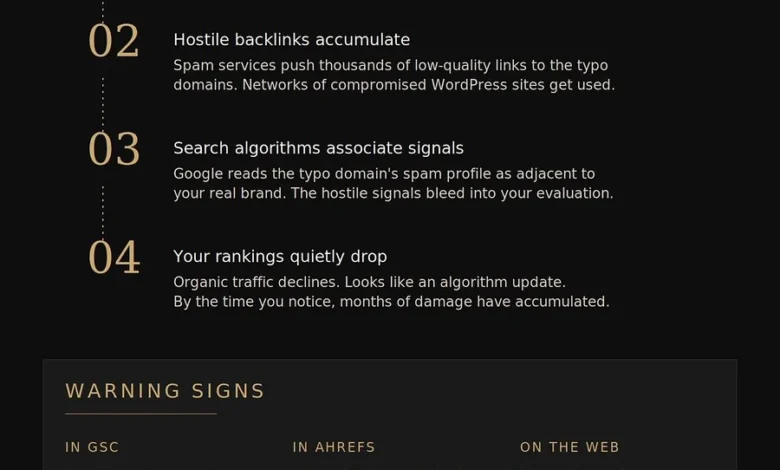
The new pattern observed in the luxury jewelry space is significantly more sophisticated. These typosquatted domains are not hosting fake shops or phishing pages. In many instances, they host no content at all, existing as "parked" pages with zero outbound links. Their power lies in their inbound link profile. Attackers use automated infrastructure to build thousands of spam-flagged backlinks to these misspelled domains over a period of weeks.
The objective is to exploit how modern search engines, particularly Google, interpret brand identity and authority. Search algorithms do not merely evaluate a domain in isolation; they analyze the "signal landscape" surrounding a brand name. When a domain that is nearly identical to a legitimate brand becomes associated with massive amounts of link spam, the negative signal can "bleed" into the real brand’s evaluation. This results in the legitimate site being penalized or devalued in search rankings, leading to a loss of visibility for high-value queries.
Chronology of the 2024 Jewelry Sector Attacks
The intensification of these coordinated attacks became markedly visible in late 2024. While routine spam has always been a factor in web management, the current wave is characterized by professional-grade infrastructure. Analysts have identified several stages in the deployment of these campaigns:
- Reconnaissance and Domain Acquisition: Attackers identify high-performing luxury retailers and register clusters of four to five typosquatted variants.
- Backlink Bombardment: Utilizing link-spam services and networks of compromised WordPress sites, attackers inject commercial anchor text into thousands of low-quality pages pointing toward the typosquatted domains.
- Algorithmic Association: As search engine crawlers index these links, the proximity of the typosquatted name to the real brand begins to corrupt the brand’s overall "trust score."
- Monetization of Displacement: As the legitimate brand drops in Search Engine Results Pages (SERPs), competitors or the attackers’ own affiliate sites move up to capture the displaced traffic.
The owner of Opulent Jewelers noted that the attacker’s infrastructure often involves aged-domain marketplaces where hostile profiles are recycled across multiple targets. This suggests a systematic approach rather than an isolated grievance.
Economic Drivers: Why High-End Jewelry is the Primary Target
The selection of the luxury jewelry industry for these attacks is a matter of calculated economics. Several factors make this sector uniquely vulnerable and lucrative for bad actors.
High Average Order Value (AOV)
In the world of pre-owned Cartier Love bracelets or authenticated Van Cleef & Arpels Alhambra pieces, individual transactions frequently reach four or five figures. Because the margins and price points are so high, even a marginal decrease in organic traffic—such as a 5% dip—can translate into hundreds of thousands of dollars in lost annual revenue. The economic impact of a ranking drop is far more severe here than in lower-cost retail sectors.
Competitive Keyword Density
The keyword landscape for luxury jewelry is highly specific and intensely competitive. Phrases such as "pre-owned luxury watches" or "authenticated estate jewelry" have immense commercial intent. There is a limited "inventory" of top-tier ranking positions for these terms. By pushing a primary competitor down even one or two positions on a SERP, an attacker can fundamentally shift the flow of capital in the market.
The Vulnerability of Trust-Based Content
Authenticators and luxury retailers invest heavily in high-quality content, including provenance documentation, high-resolution photography, and educational guides. This content is designed to build trust but also serves as the primary engine for organic search growth. Negative SEO attacks specifically target this "authority" by associating the brand’s name with the "neighborhood" of web spam, effectively weaponizing the brand’s own reputation against it.
Technical Indicators and Detection Protocols
For many jewelers, the symptoms of an attack are often mistaken for general algorithm updates or seasonal fluctuations. However, specific technical markers exist that can confirm a coordinated negative SEO campaign.
Google Search Console (GSC) Anomalies
The most immediate evidence is found in the "Links to your site" report. Jewelers should monitor for sudden spikes in referring domains that have no correlation with marketing campaigns. Of particular concern are links originating from regions where the business does not operate, or links featuring anchor text that combines the brand name with unrelated commercial terms (e.g., "discount [Brand Name]" or "buy [Brand Name] cheap").
Backlink Monitoring Tools
Using professional tools like Ahrefs, Semrush, or Moz, retailers can identify referring URL paths that contain randomized hash strings or auto-generated patterns. A hallmark of a compromised site used in these attacks is a domain with an unnaturally high outbound link count—often thousands of unrelated links pointing to various targets.
Typosquat Identification
Proactive monitoring for domain registrations is essential. A cluster of domains registered with single-letter variations of a brand name that host no content but show rapid backlink growth is a definitive signal of an impending or ongoing attack. There is no legitimate reason for a misspelled, empty domain to accumulate thousands of backlinks.
Strategic Defense: The Layered Response Model
Defending against typosquatting and negative SEO requires a multi-faceted approach. Because search engines are automated, the defense must also involve a level of systematic management.
The Disavow Protocol
The primary defensive tool is the Google Search Console disavow file. This allows a site owner to instruct Google to ignore specific domains or URLs when evaluating their site’s link profile. For retailers under active attack, this file must be treated as living infrastructure. Some luxury brands now maintain disavow lists containing thousands of domains, with weekly audits to ensure new spam vectors are neutralized.
Formal Spam Reporting
While the disavow tool protects the victim’s site, it does not remove the offending typosquatted domain. Submitting formal spam reports to Google is a necessary step. By flagging these domains for "paid links" or "malware," retailers contribute to the algorithmic "blacklisting" of the attacker’s infrastructure.
The Role of Intellectual Property and Legal Recourse
If the attack causes documented financial damage, legal avenues become viable. Two primary frameworks exist for this purpose:
- UDRP (Uniform Domain-Name Dispute-Resolution Policy): Managed by the World Intellectual Property Organization (WIPO), this is an administrative process designed to resolve cases of cybersquatting. It is relatively fast (60–75 days) and cost-effective, with filing fees typically around $1,500. A successful UDRP action results in the transfer or cancellation of the typosquatted domain.
- ACPA (Anticybersquatting Consumer Protection Act): In the United States, this federal law allows trademark owners to sue for statutory damages ranging from $1,000 to $100,000 per domain. While more expensive and time-consuming than UDRP, the threat of high statutory damages can serve as a powerful deterrent against domestic attackers.
Both strategies require the business to have established trademark rights. Experts suggest that federal trademark registration is a critical piece of digital "armor" that simplifies the process of reclaiming typosquatted domains.
Industry Implications and the Future of Search Integrity
The emergence of this threat highlights a fundamental challenge in the architecture of the modern internet: search engines rely on external signals to determine trust, but those signals can be forged. As long as link velocity and brand association remain key ranking factors, they will be targets for manipulation.
For independent jewelers and boutiques, the resource asymmetry is particularly challenging. Attackers can deploy automated scripts at a low cost, while the defender must invest in SEO expertise, monitoring software, and legal counsel. This "defense tax" is becoming an unavoidable cost of doing business in the luxury e-commerce space.
The consensus among digital security experts and luxury retailers is that awareness is the first line of defense. The "biggest barrier," as noted by industry veterans, is that many jewelers remain unaware that this specific class of attack exists. By the time they realize their rankings are sliding, the "poisoning" of their brand signal may already be advanced.
In the long term, the responsibility for mitigating these attacks lies partially with search engine providers. Algorithms must become more adept at distinguishing between legitimate brand signals and coordinated "bleed" from typosquatted spam clusters. Until then, the luxury jewelry industry must remain vigilant, treating SEO not just as a marketing discipline, but as a critical component of their cybersecurity and brand protection strategy. Documentation, proactive monitoring, and a willingness to engage in legal and technical defense are no longer optional; they are the requirements for survival in an increasingly hostile digital marketplace.