The New Threat Landscape: How Typosquatting and Negative SEO are Targeting Luxury Jewelry E-commerce

The first indication that something was fundamentally wrong for Opulent Jewelers did not arrive via a customer complaint or a sudden drop in quarterly revenue. Instead, it surfaced as a quiet, anomalous entry in a Google Search Console disavow report: a spike of several hundred referring domains appearing within a single week. None of these domains possessed any relevance to the jewelry industry, nor did they hold any historical credibility. Upon closer forensic examination, it became clear that these domains were not random junk traffic; they were part of a coordinated, strategic campaign targeting luxury jewelry retailers with a specific, technical maneuver that blends typosquatting with negative search engine optimization (SEO).
This emergence represents a shift in the threat landscape for e-commerce, particularly for high-end retailers. Unlike traditional phishing—which aims to steal credit card data or login credentials—this new breed of attack is designed to degrade the search engine authority of a brand from the inside out. For many business owners, these attacks remain invisible until organic search rankings begin to decline, often misinterpreted as a standard algorithm update or seasonal fluctuation. Industry experts have identified that this pattern has been quietly targeting the luxury jewelry sector for at least eighteen months, evolving from simple spam into a sophisticated, multi-layered threat.
Anatomy of the Attack: A Two-Pronged Strategy
To understand this threat, one must distinguish between the classical definition of typosquatting and the modern, weaponized version currently impacting the market. Traditional typosquatting involves registering domain names that are minor misspellings of a target brand, typically to redirect users to a malicious site or to capture credentials. In contrast, the current campaign observed in the jewelry sector is entirely devoid of user-facing content.
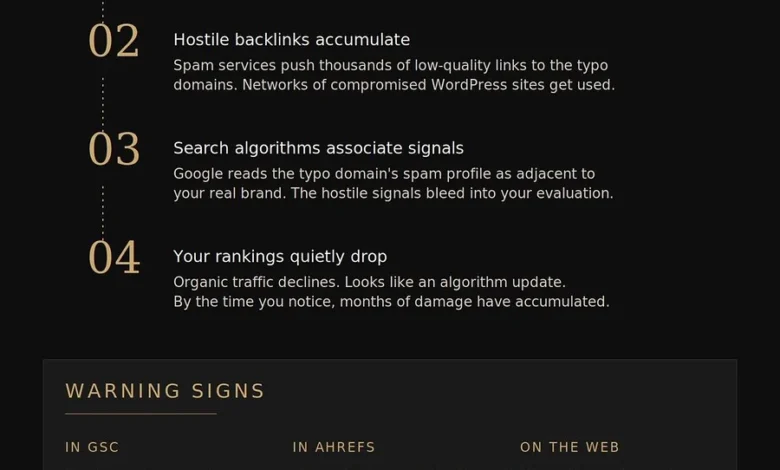
These typosquatted domains often remain empty, parked pages with no outbound links. Their utility lies not in what they display, but in their link profiles. Attackers populate these domains with thousands of low-quality, spam-flagged backlinks, building a toxic "link neighborhood" around the misspelled domain. Because the domain name is a near-match to a legitimate luxury brand, Google’s algorithms—which rely on signals from the broader web—begin to associate the reputation of the legitimate brand with the hostile backlink profile of the typosquatted site.
The goal is to pollute the brand’s digital identity. By creating a dense web of spam-related links that point to a "brand twin," the attacker forces the search engine to downgrade the primary domain’s authority. This leads to a systematic decline in organic visibility, pushing legitimate retailers off the first page of search results for high-intent keywords.
Why Luxury Jewelry Has Become a Primary Target
The targeting of the jewelry sector is not a matter of chance; it is a calculated decision based on the specific economics and search behavior inherent to the luxury market. Several factors make this industry particularly vulnerable:
- High-Value Transactions: In the pre-owned luxury market, where single transactions can reach four or five figures, even a marginal decline in organic traffic results in significant, compounding revenue losses. The return on investment for an attacker—if they are operating as a competitor or a malicious affiliate—is substantial.
- Specific Keyword Landscapes: Keywords associated with authenticated, pre-owned luxury goods—such as "pre-owned Cartier Love bracelet" or "authenticated Van Cleef Alhambra"—are highly competitive. Because the pool of authoritative, verified retailers is limited, even a minor drop in search ranking can effectively shift thousands of dollars in potential sales to a rival.
- Authentication as a Vulnerability: Luxury brands thrive on trust, built through rigorous authentication processes and detailed documentation. Because these retailers publish content-rich, authoritative material to prove provenance, their websites have a large, indexable footprint. Attackers exploit this by leveraging the brand’s established trust signals, hoping to overwhelm them with noise.
Chronology and Escalation
The pattern began to intensify in the latter half of 2024. Initial assessments suggested that the influx of links was merely standard web spam, which most mature websites experience intermittently. However, as the volume grew and the links became more uniform, it became clear that the infrastructure was deliberate.
Investigations into the source of these attacks revealed that the perpetrators are utilizing automated link-spam services. These platforms openly advertise their ability to manipulate search rankings through "negative SEO." Furthermore, the use of compromised WordPress sites to inject commercial anchor text and the acquisition of aged domains to host these spam profiles indicate a level of investment that moves beyond amateur annoyance into professional-grade cyber-interference.
Detecting the Digital Breach
For many retailers, the symptoms of these attacks are often misdiagnosed. A comprehensive, data-driven approach to monitoring is essential for early detection. Retailers should audit their Google Search Console and backlink monitoring tools (such as Ahrefs, SEMrush, or Moz) for the following indicators:
- Disavow Anomalies: Unexplained, rapid spikes in referring domains that do not correlate with any legitimate marketing or PR campaigns.
- Commercial Anchor Text Mismatches: The appearance of links with aggressive, commercial-intent anchor text (e.g., "discount [brand name]") from low-authority or unrelated domains.
- Geographic Mismatches: A sudden surge in inbound links originating from countries or regions where the brand does not conduct business or has no customer base.
- Typosquat Clusters: The identification of multiple domain registrations that are single-letter variations of the brand, particularly if these domains are accumulating backlinks but lack actual website content.
A Layered Defensive Strategy
Defending against this form of digital sabotage requires a combination of technical maintenance and legal vigilance. There is no singular "off" switch, but rather a series of defensive layers.
1. Proactive Disavowal
The Google Search Console "Disavow Tool" remains the primary defensive instrument. By identifying and submitting toxic referring domains to Google, a brand can instruct the algorithm to disregard those links when calculating site authority. In an active attack scenario, this must be treated as an ongoing maintenance task, with files updated weekly or monthly to keep pace with the attacker’s efforts.
2. Strategic Spam Reporting
While Google’s spam reporting forms do not guarantee an immediate removal of the offending domain, they are critical for long-term intelligence. Reporting these domains as "paid links" or "link spam" feeds into Google’s machine learning systems, helping the algorithm identify and discount these patterns globally over time.
3. Legal Recourse: UDRP and ACPA
When the financial damage is significant, brands may pursue legal remedies. The Uniform Domain-Name Dispute-Resolution Policy (UDRP) provides a framework for the cancellation or transfer of domains registered in bad faith. While this process is relatively cost-effective—typically costing around $1,500—it requires clear evidence of trademark rights. Alternatively, the Anticybersquatting Consumer Protection Act (ACPA) in the United States offers a path to federal litigation, potentially allowing for significant statutory damages. However, this is a much more intensive and expensive legal route.
4. Documentation as Evidence
Retailers must maintain a meticulous log of all suspicious activity. Screenshots of WHOIS data, exports of backlink profiles, and a timeline of when each variant appeared are essential. This evidence is the difference between a successful legal filing and an expensive, fruitless endeavor.
Pitfalls in Defensive Response
It is equally important for brand owners to understand what not to do. Some common, instinctive reactions can inadvertently harm the victim’s position:
- Avoid Phishing Reporting: Reporting typosquats to services like Cloudflare as "phishing" is generally ineffective, as these services often define phishing narrowly as the theft of credentials. Mislabeling the report can lead to the dismissal of legitimate claims.
- Refrain from Purchasing Typosquats: Buying the misspelled domains to "protect" them is often a mistake. If the domain has already been used in a negative SEO campaign, it carries a "poisoned" link profile. Purchasing it means inheriting that toxicity, which can then negatively impact the brand’s primary site if the domains are redirected.
- Do Not Engage: Publicly calling out the attacker or engaging with them directly rarely yields results. It often serves only to alert the perpetrator that the attack is successful, potentially prompting them to escalate their efforts.
The Broader Implications for E-commerce
The rise of typosquatting coupled with negative SEO serves as a stark reminder of the "architectural reality" of search engines. Because Google’s ranking algorithms must rely on external signals to establish trust and relevance, they are inherently susceptible to manipulation when those signals are faked at scale.
Until search engine technology evolves to better distinguish between legitimate brand signals and fabricated, malicious link networks, the burden of protection rests with the brand owners. For small to mid-sized jewelry retailers, the asymmetry of resources is a daunting challenge. The attacker requires only a few automated scripts and a small budget for domain registrations; the defender requires constant vigilance, technical oversight, and often, legal counsel.
The path forward for the industry lies in education and collaboration. As more jewelers share their experiences and identify these patterns earlier, the cost-benefit analysis for the attacker changes. When defensive measures are applied consistently and across the board, the ease of these attacks diminishes. Awareness is the most effective deterrent, and the ability to notice the subtle signals of a digital intrusion is now a foundational requirement for any luxury brand operating in the modern e-commerce ecosystem.
Related posts: