The Great Calibration: Adland Grapples with the Reality of AI-Driven Standards in 2026

It is the autumn of 2026, and as the global advertising industry descends upon the year’s most significant conference circuit, the discourse has undergone a profound transformation. While the initial fervor surrounding artificial intelligence once focused on the breathless promise of "innovation" and "efficiency," the industry’s tone has shifted toward a more sober, even weary, reality. As the high-velocity adoption of AI tools has coincided with widespread workforce restructuring and the subsequent erosion of output quality, brand-side marketers are now grappling with a sobering question: how can the advertising industry reclaim the standards that define premium brand equity in an era dominated by automation?
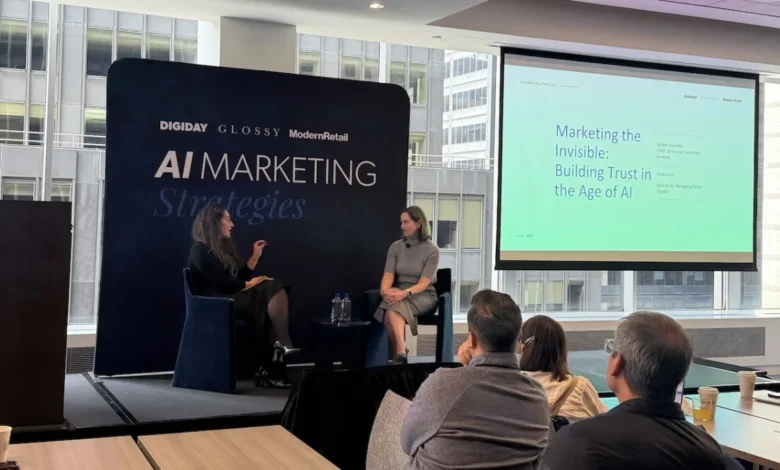
The inaugural AI Marketing Strategies event, co-hosted on September 24 by Digiday, Glossy, and Modern Retail, served as the epicenter for this realization. Behind the closed doors of a Chatham House Rule town hall, brand leaders gathered to confront the friction between the promise of machine-speed content generation and the persistent, human requirement for brand integrity.
The Erosion of Standards in the Age of Automation
The primary catalyst for this industry-wide anxiety is a palpable decline in creative quality. As agencies and internal marketing teams race to replace labor with automated workflows, the "good enough" threshold has become the industry’s new, albeit dangerous, standard. For luxury and premium brands, where brand equity is inextricably linked to visual and narrative precision, the consequences are stark.
"The quality control is so bad," remarked one attendee representing a premium beauty brand during the town hall. "Establishing brand standards into AI-driven ad platforms is proving to be a massive, systemic challenge."
The consensus among many brand-side participants is that the current reliance on AI is not a turnkey solution, but a labor-intensive bridge. One marketer described their reality as the "10/80/10 formula": ten percent of their time is spent on precise upfront prompting, eighty percent is handled by the AI, and the final ten percent is dedicated to intensive manual refinement to ensure the work meets professional standards.
The disconnect is further exacerbated by the relationship between brands and their agency partners. Several brand-side representatives expressed frustration that agencies appear increasingly motivated by cost-cutting through junior-level staffing and automated output rather than the safeguarding of the client’s reputation. Reports of misaligned logos, tone-deaf copy, and generic creative executions have prompted several brands to mandate strict human oversight protocols before any AI-generated campaign is permitted to go live.
A Chronology of the AI Shift
To understand this current malaise, one must look back at the rapid trajectory of the last 24 months. By early 2025, the industry had moved past the "experimentation phase," with major holding companies like WPP, Publicis, and Omnicom integrating generative AI into the core of their service models. This was characterized by a push for "hyper-personalization" and "massive scale."
However, the middle of 2025 saw the "correction phase." As layoffs became a fixture in the advertising job market, the brain drain of mid-level creative staff—those responsible for the meticulous quality control that prevented technical errors—became apparent. By the spring of 2026, data from industry analysts began to show a divergence: while volume metrics for ad campaigns increased by nearly 40% year-over-year, engagement rates for "pure-play" AI content began to stagnate or decline, signaling audience fatigue with low-quality, synthetic advertising.
This current fall cycle, therefore, marks the "calibration phase." The industry is no longer asking if they should use AI, but rather how to build the necessary guardrails to prevent the further dilution of brand value.
The Human Element and Change Management
The challenge of "change management" dominated the conversation at the September event. Leaders are beginning to realize that the transition to an AI-first marketing environment is not merely a technological upgrade but a structural redesign of the workplace.
The primary conflict lies in the speed of delivery. "With AI, you can get to where you need to be in terms of campaign implementation within weeks," noted one agency executive. "But with AI, you can get there within hours. So, you have to ask yourself: what is the value of your employees on top of that?"
This sentiment echoes the anxieties that permeated the digital transition of the early 2000s. Just as the emergence of the internet forced traditional agencies to rethink their structure, the rise of AI is forcing a re-evaluation of the role of the creative professional. The consensus is that the most valuable employees will not be those who can generate the most content, but those who can act as "curators" and "editors" of the machine’s output.
Strategic Shifts: Measuring the Gap
Beyond the immediate crisis of quality control, the industry is also struggling with the changing nature of the internet itself. Isabel Perry, global EVP of strategy at DEPT, highlighted a shift toward an internet where bot-driven traffic is beginning to outpace human engagement.
"We are drowning in measurement," Perry argued during her keynote. "Instead of just measuring numbers, we need to measure gaps." Her assertion is that marketing budgets are currently being misallocated to chase "semi-generic" metrics—vanity figures that look good in a report but offer little strategic insight. She proposed a framework where budgets are allocated based on which parts of the consumer journey remain fundamentally human versus those that can be safely offloaded to agents or bots.
This aligns with the "zero-click" reality discussed by Rajiv Ragu, VP of Digital at Thorne. As search and discovery shift toward AI-curated summaries and agentic responses, brands face a new challenge: how to remain relevant in a world where users no longer click through to a website. Ragu emphasized the necessity of curating legacy content. "You need to see what content is still being picked up," Ragu noted. "Keeping content libraries relevant takes investment—updating authorship and the information itself—but it shouldn’t be overlooked, as there is potential risk for brand damage if neglected."
Implications for the Future of Advertising
The broader implication for the industry is clear: we are moving into an era of "curated intelligence." The "good enough" era of AI-generated content is likely to be a short-lived anomaly. As brands recognize that generic, AI-slop damages their long-term credibility, they will likely shift their spending toward human-in-the-loop agencies that can guarantee creative rigor.
Data from the third quarter of 2026 suggests a growing premium on "verified human" creative services. Agencies that can demonstrate a robust, human-centric quality assurance process are seeing a resurgence in client interest, even if their turnaround times are slower than their fully-automated counterparts.
Furthermore, the legal and ethical landscape is tightening. With regulators in the U.S. and the EU signaling a more aggressive stance toward AI transparency, brands are being forced to adopt more rigorous auditing processes for their content. The "black box" approach to advertising—where the agency provides a final product without transparency regarding how much of it was machine-generated—is becoming a liability.
As the industry moves into 2027, the focus will likely remain on this "calibration." The goal is to move from the chaotic, unfettered expansion of the AI era into a period of sustainable, high-quality integration. For those brands and agencies that can master the balance between machine-speed efficiency and human-centered quality, the future remains bright. For those who remain tethered to the "good enough" mentality, the risk of brand obsolescence has never been higher.
The industry has reached a crossroads where the technology is no longer the story; the story is now the resilience of the human touch in an increasingly synthetic world. The lessons learned during the 2026 conference season will likely dictate the winners and losers of the next decade of advertising.