Autologous Micrografting Technology: A New Frontier in Non-Surgical Hair Restoration and Follicle Preservation


The psychological weight of male pattern baldness often begins with a casual glance into an overhead-lit mirror or the unintended activation of a front-facing smartphone camera. For decades, men facing the early stages of hair thinning were left with a stark binary choice: accept the progressive loss of their hair or commit to an invasive and expensive surgical hair transplant. However, a rapidly evolving middle tier of regenerative medicine has emerged to bridge this gap, offering preventative and restorative interventions that target follicles before they are permanently lost. Among the most closely watched developments in this category is Autologous Micrografting Technology (AMT), a tissue-transfer protocol frequently marketed under the umbrella of stem cell and exosome therapy.
Defining Autologous Micrografting Technology and Its Underlying Mechanisms
To understand AMT stripped of commercial hyperbole, it is necessary to examine it as a localized tissue-transfer procedure rather than a pharmacological drug or surgical relocation. The procedure begins when a clinician extracts two or three microscopic 2.5-millimeter skin punches, typically gathered from the mastoid region behind the ear or the lower nape of the neck. These donor sites are specifically chosen because hair follicles in these anatomical zones are genetically resistant to dihydrotestosterone (DHT), the primary hormone responsible for androgenetic alopecia.
Once harvested, the tissue samples are placed into a specialized mechanical medical device that disintegrates and filters the tissue into a concentrated liquid suspension. This suspension contains progenitor cells, native growth factors, and signaling vesicles known as exosomes, all derived entirely from the patient’s own body. Nothing is cultured in an external laboratory, nothing is frozen, and no donor tissue is utilized.
The resulting fluid is then reintroduced across thinning areas of the scalp via a grid of targeted mesotherapy injections. According to the current medical literature, the primary mechanism of AMT does not involve the creation de novo of entirely new hair follicles. Instead, the introduction of cytokines, growth factors, and exosomes delivers biochemical signals that suppress programmed cell death within existing follicles, reduce localized micro-inflammation, and stimulate microvascular blood supply. Essentially, the treatment communicates with struggling, miniaturized follicles to halt their regression and extend their growth phase.
Dr. Marco Nicoloso, Medical Director at the Ouronyx clinic in London, emphasizes the regenerative nature of the process. He notes that micrografting utilizes tiny samples of unaltered patient tissue containing natural components already recognized and accepted by the body. By introducing mature multipotent stem cells and growth factors back into balding zones, the treatment aims to reinstate growth signaling and reverse the miniaturization process typical of androgenetic alopecia.

Despite optimistic clinical framing, medical consensus maintains a clear boundary regarding the generation of new hair. As clinical guidelines and conservative practitioners frequently clarify, micrografting does not generate entirely new follicles on a completely bald scalp. Rather, it optimizes existing follicular units, causing sparse areas to appear denser and fuller by reversing miniaturization. Consequently, patients with advanced, established bald patches are generally not suitable candidates; AMT is fundamentally designed as a preservation strategy for those in the early to moderate stages of hair thinning.
The Clinical Protocol and Patient Experience
The procedural journey typically begins with a rigorous baseline consultation incorporating high-magnification 3D trichoscopy. Systems such as TrichoLAB map follicle density, individual hair caliber, and scalp inflammation, establishing quantifiable coordinates that can be reliably tracked over subsequent months. This diagnostic imaging transforms subjective concerns about thinning hair into objective, measurable data.
A standard AMT session requires approximately one hour from start to finish. Local anesthesia is administered to the donor site behind the ear before the tissue punches are extracted—a process generally described as producing localized pressure rather than sharp pain. While the tissue is processed chairside, the patient waits briefly before the concentrated suspension is injected across the designated thinning zones. While patients report that the scalp injections can cause mild discomfort, the procedure requires no general anesthesia, surgical incisions, or post-treatment bandages.
Post-procedural recovery is exceptionally minimal, though minor aesthetic considerations remain. Small adhesive strips or plasters typically cover the donor sites for approximately 48 hours, leaving minute red dots that usually fade and disappear as surrounding hair regrows within a fortnight. Patients are generally able to resume normal daily activities immediately following the appointment, though individuals with tightly cropped hairstyles or upcoming high-profile social engagements are advised to factor in a brief healing window for the donor marks.
Quantitative Findings and Longitudinal Results
Evaluating the efficacy of AMT relies heavily on comparative trichoscopic data gathered across standardized timeframes. Clinical case studies tracking patients over a four-month period demonstrate notable quantitative improvements across various treated scalp zones compared to untreated reference areas.
In vertex and crown regions, data often reveals significant increases in total hair density per square centimeter, alongside improvements in cumulative hair thickness—a combined metric of density and individual caliber. Frontal and temporal zones frequently exhibit even higher percentage gains in hair count and a measurable shift in the ratio of vellus (fine, wispy) hairs to terminal (thick, mature) hairs. This positive structural shift directly opposes the traditional trajectory of androgenetic alopecia, frequently resulting in improved standardized clinical scores, such as the Sinclair scale.
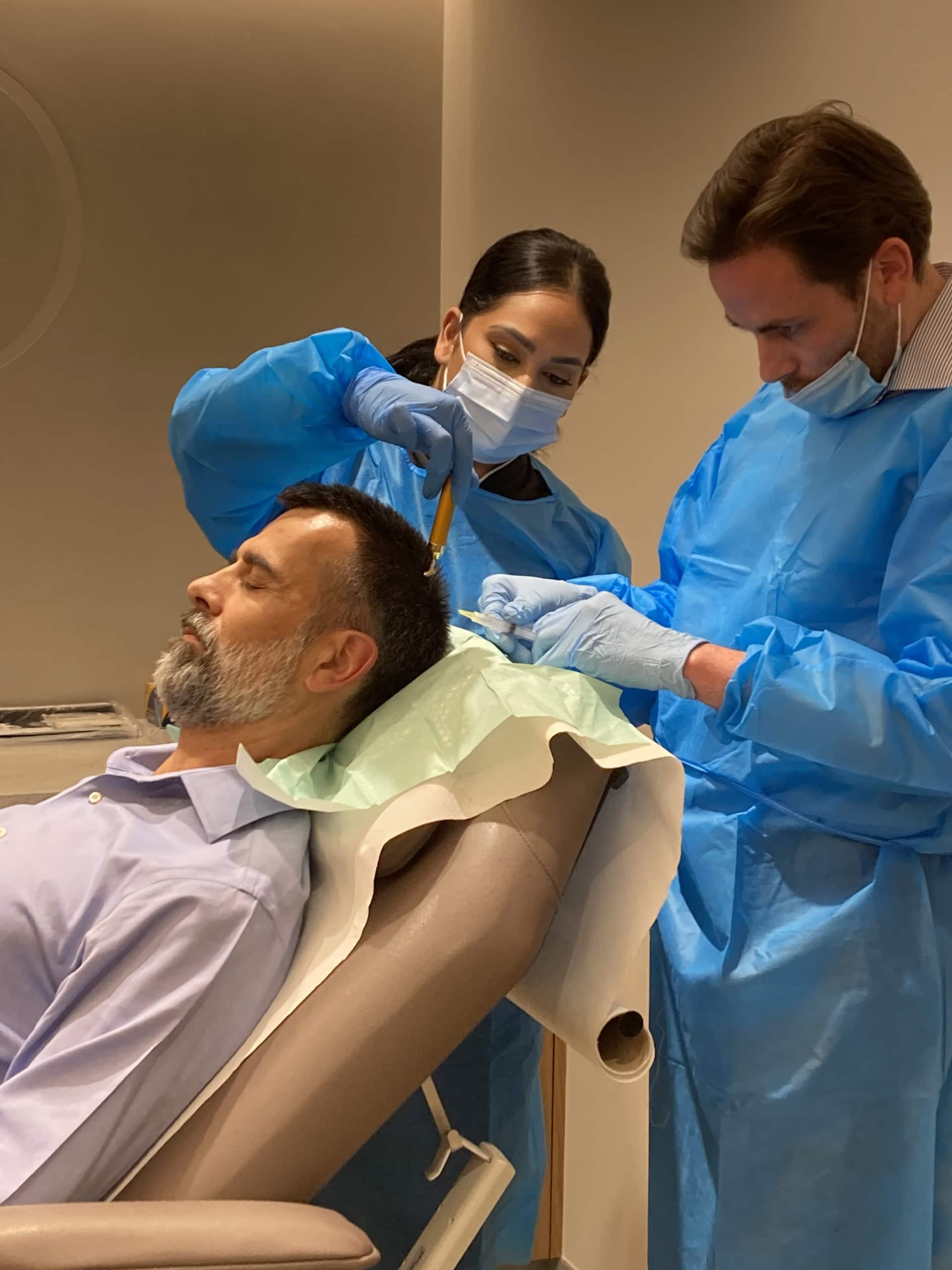
However, isolating the precise variable responsible for these improvements can be complex. Many patients concurrently initiate complementary medical therapies, such as topical minoxidil or oral 5-alpha-reductase inhibitors, around the same period. Because pharmacological treatments typically require three to six months to yield visible changes, rapid early improvements are frequently credited to the immediate biochemical signaling of AMT. Nonetheless, clinical transparency dictates acknowledging that multi-modal approaches make it difficult to attribute results exclusively to a single intervention.
Comparative Analysis: AMT Versus Alternative Hair Loss Interventions
Patients exploring modern hair restoration face a crowded marketplace populated by fundamentally distinct modalities. Understanding how AMT compares to alternative treatments is essential for managing expectations and financial investment:
- Autologous Micrografting Technology (AMT): Focuses on signaling existing, struggling follicles to preserve and thicken hair using the patient’s own processed tissue. It involves a single sitting, minimal downtime, and is best suited for early-to-moderate thinning.
- Follicular Unit Extraction (FUE) Hair Transplant: The only surgical option that physically relocates DHT-resistant follicles from the back of the head to completely bald areas. It is ideal for restoring recessed hairlines or filling established bald patches, requiring a surgical recovery period of several weeks and months for final growth.
- Platelet-Rich Plasma (PRP): Involves spinning a patient’s blood to isolate platelets, which are then injected into the scalp to deliver growth factors. While sharing a similar regenerative philosophy with AMT, PRP delivers plasma proteins rather than progenitor cells, typically requiring an initial series of three to six sessions followed by regular maintenance.
- Off-the-Shelf Exosome Treatments: Utilizes donor-derived vesicles commercially purchased in vials rather than harvested from the patient’s own body. This category has attracted significant regulatory scrutiny regarding safety, provenance, and legal compliance.
While PRP remains a popular and widely accessible entry point for preventative care, micrografts distinguish themselves by delivering actual progenitor cells alongside growth factors. Whether this biological distinction justifies the higher price point—with AMT treatments typically priced around £2,950 per session—remains an individual evaluation for the consumer.
The Regulatory Landscape of Exosome Therapy
The commercial explosion of "exosome therapy" across the aesthetic and wellness industries has introduced considerable regulatory ambiguity. In the United Kingdom, the Medicines and Healthcare products Regulatory Agency (MHRA) classifies injected exosomes as medicinal products. Currently, no injectable exosome product holds a formal UK marketing authorisation for cosmetic or aesthetic applications, and human-cell-derived allogeneic products intended for cross-patient injection face stringent legal and safety barriers.
Independent medical authorities and pathologists have frequently cautioned consumers against clinics offering commercialized, donor-derived exosome serums sourced from external laboratories. The risk profile associated with introducing foreign cellular material into a recipient scalp without strict pharmaceutical oversight has raised alarm bells throughout the medical community.
AMT circumvents many of these regulatory and ethical concerns by strictly adhering to an autologous framework. Because the exosomes and progenitor cells utilized in the procedure originate entirely from the patient’s own tissue, processed and reintroduced during the same clinical appointment, the procedure avoids the complications associated with donor materials. Medical professionals emphasize that consumers should persistently interrogate aesthetic providers regarding the precise origin of any cellular or vesicular products being injected into their bodies.

Maintenance Schedules, Economic Considerations, and Future Outlook
A notable divergence exists within the aesthetic industry regarding how frequently micrografting treatments must be repeated. While some clinics advocate for standardized maintenance protocols requiring repeat sessions every 12 to 18 months, published clinical trials on analogous micrografting systems suggest that subsequent treatments within the first year may yield negligible additional benefit over a single well-executed session.
Consequently, leading practitioners recommend a data-driven approach: undergoing an initial treatment, tracking progress via standardized trichoscopic scans at six and twelve-month intervals, and basing subsequent interventions on documented changes in hair density rather than arbitrary calendar timelines.
Priced competitively against surgical hair transplants—which routinely exceed £3,000 to £10,000 depending on graft count—AMT occupies a high-value niche for individuals aiming to delay or avoid invasive surgery entirely. While significantly more expensive than over-the-counter or generic topical medications, its single-session convenience and biological autologous safety profile provide an appealing option for modern consumers.
Ultimately, Autologous Micrografting Technology represents a significant maturation in non-surgical hair restoration. By leveraging the body’s own regenerative signaling pathways to rescue miniaturizing follicles, AMT offers a scientifically grounded middle ground for individuals seeking proactive intervention before permanent hair loss sets in.