Interspare builds on Indian installations with major showcase at India ITME 2026

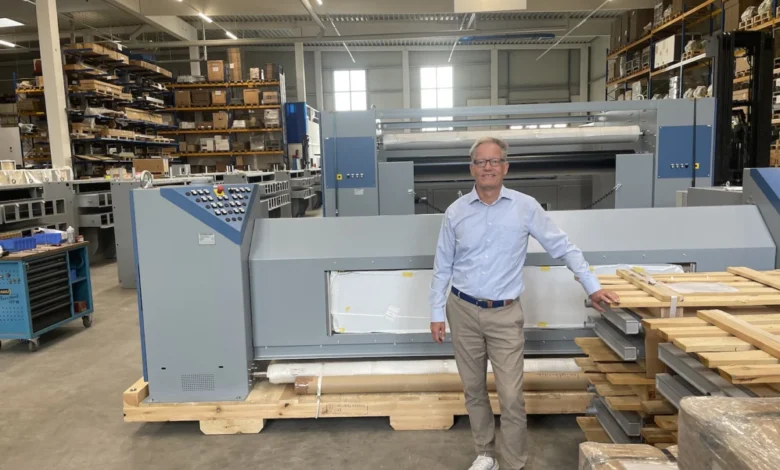
Following the recent successful commissioning of four state-of-the-art Krantz finishing units across the Indian subcontinent, German textile machinery specialist Interspare Textilmaschinen is set to make a significant impression at the upcoming India ITME 2026. The event, scheduled to take place in Greater Noida from December 4–9, serves as a pivotal platform for the company to solidify its footprint in one of the world’s fastest-growing textile manufacturing hubs. Interspare will be exhibiting in Hall 7 at stand H7L2, supported by its long-standing strategic partner, the Global Group of Marketing.
This exhibition marks a deliberate shift in Interspare’s regional strategy. By focusing on both the deployment of high-performance new machinery and the implementation of sophisticated modernisation programmes for legacy equipment, the company is addressing the dual needs of India’s maturing textile sector: rapid expansion and operational sustainability.
The Legacy of German Engineering in India
The Indian textile industry has long held a deep affinity for German engineering, particularly regarding the prestigious brands Krantz, Artos, and Babcock. These names represent a standard of durability and precision that has underpinned Indian fabric production for decades. Interspare, acting as the steward of these legacies, finds itself in a unique position to bridge the gap between historic reliability and modern digital demands.
Managing Director Dirk Polchow notes that while these brands enjoy an "excellent reputation" in the region, the goal for 2026 is to reintroduce these capabilities to a new generation of textile entrepreneurs. Many of the newer market entrants in India, focused on technical textiles and high-end fashion, may not be fully aware of the technological evolution these machines have undergone under Interspare’s stewardship. The company’s presence at India ITME is a calculated move to capture this segment of the market, which is increasingly seeking high-efficiency, energy-conscious solutions.
Technological Advancements: The Krantz K30 Stenter
At the core of Interspare’s technological showcase is the Krantz K30 stenter. This machine has become synonymous with energy efficiency in high-speed textile finishing. Central to its operation is the patented Econ-Air airflow system, a design originally pioneered by Babcock.
The Econ-Air system is highly regarded for its ability to optimize thermal energy. Instead of exhausting hot air prematurely, the system circulates it through the drying compartments until the air has reached a saturation point regarding moisture absorption. This iterative reuse of heated air drastically reduces energy waste—a critical factor for Indian manufacturers facing rising energy costs and stricter environmental regulations.

When paired with Star-Jet or Convey-Air nozzle technologies, the K30 provides an unprecedented level of control over the drying and finishing process. By ensuring uniform air and temperature distribution across the entire fabric width, the system mitigates the risk of uneven finishing, which is a common pain point in the production of both delicate knits and robust woven fabrics. Furthermore, the K30’s cast-chain system has been engineered to minimize friction and tension, extending the operational life of the machine even under the grueling 24/7 production schedules common in large-scale Indian textile mills.
Modernisation as a Sustainable Imperative
While the sale of new machinery remains a primary revenue driver, Interspare has identified a significant market opportunity in the modernisation of existing infrastructure. With thousands of Krantz, Artos, and Babcock units currently in operation worldwide—many of which have been running for over 30 years—the industry faces a choice between costly replacement and strategic upgrading.
Interspare’s EMU (Expansion, Modernisation, and Upgrading) programme offers a modular, cost-effective alternative to purchasing new equipment. The programme addresses the "bottlenecks" of ageing machinery, which are typically found in the control systems and drives rather than the mechanical frames.
Typical projects under the EMU umbrella include:
- Controller Migration: Replacing legacy Siemens S5 controllers with modern, high-speed VIPA systems.
- Drive Optimization: Upgrading aging frequency converters with advanced Lenze technology to improve torque control and energy recovery.
- Interface Overhaul: Replacing clunky, outdated industrial PCs with intuitive, high-resolution Siemens Comfort Panels.
These upgrades do more than simply extend the operational lifespan of the machine; they provide a gateway to Industry 4.0. By retrofitting older machines with modern sensors and data acquisition interfaces, manufacturers can begin collecting real-time process data, allowing for better quality control and predictive maintenance.
The Role of Artificial Intelligence and Process Digitisation
Looking beyond mechanical hardware, Interspare is expected to unveil new initiatives at India ITME 2026 centered on the integration of Artificial Intelligence (AI) in textile finishing. The transition from manual process monitoring to AI-assisted oversight represents the next frontier in the textile sector.
By leveraging machine learning algorithms, Interspare aims to assist operators in predicting fabric behavior during the drying process, automatically adjusting airflow and temperature parameters to prevent defects before they occur. This focus on "smart" finishing aligns with the broader Indian government initiatives, such as "Make in India," which encourage the adoption of advanced manufacturing technologies to enhance global competitiveness.

Market Context and Historical Chronology
The Indian textile market is currently undergoing a transformative period. Driven by a surge in domestic consumption and an export strategy aimed at diversifying away from traditional sourcing hubs, Indian manufacturers are investing heavily in capacity.
- 2023–2024: Increased demand for energy-efficient finishing technology due to global energy price volatility.
- 2025: Interspare intensifies its partnership with the Global Group of Marketing to provide better localized support and faster installation timelines.
- November 2026: Successful commissioning of four new Krantz finishing lines, signaling a recovery in capital expenditure spending among mid-to-large Indian textile groups.
- December 2026: Interspare’s debut at India ITME 2026, aimed at consolidating market share in the run-up to the 2027 fiscal year.
Strategic Implications for the Indian Textile Industry
The arrival of these technologies in the Indian market has broader implications for the domestic value chain. First, the reduction in energy intensity provided by systems like the Econ-Air directly supports the industry’s shift toward "green" manufacturing, which is increasingly mandated by European and North American retail brands sourcing from India.
Second, the focus on modernisation allows smaller-to-medium-sized enterprises (SMEs) to access world-class performance without the massive capital outlay required for brand-new lines. This democratic approach to technology deployment is likely to strengthen the middle tier of the Indian textile market, making it more resilient to economic fluctuations.
Finally, the collaboration between Interspare and the Global Group of Marketing serves as a case study for successful international partnership in the textile machinery sector. By combining German engineering precision with local market knowledge and on-the-ground technical support, the partnership ensures that the "downtime" associated with high-end machinery is kept to a minimum, thereby maximizing the return on investment for the end-user.
Conclusion
As Interspare prepares for its showcase in Greater Noida, the sentiment among industry analysts is one of cautious optimism. The company’s strategy—balancing the supply of high-end, energy-efficient new machinery with a robust, data-driven modernisation programme—appears perfectly tailored to the current needs of the Indian textile sector.
By demonstrating how legacy brands like Krantz can be "future-proofed" through digital integration and modular upgrades, Interspare is not just selling machines; it is offering a pathway for the Indian textile industry to move up the global value chain. Attendees at India ITME 2026 will be looking closely at how these technologies can be applied to their own specific production lines, marking a significant milestone in the ongoing modernisation of the Indian textile landscape.