Shoe Station Group Pivots Strategy Again as It Plans to Return Dozens of Rebranded Stores to Original Banners

The retail footwear landscape is witnessing yet another dramatic shift as Shoe Station Group Inc.—formerly known as Shoe Carnival Inc.—prepares to reverse course on a major operational overhaul. In a strategic announcement delivered to analysts and investors during a third-quarter earnings call, Interim President and Chief Executive Officer Cliff Sifford outlined plans to undo much of the company’s recent store conversion initiative. The latest decision means that dozens of stores previously rebranded from Shoe Carnival and Rogan’s to the Shoe Station banner will revert to their original identities by the first quarter of fiscal 2027.
This ongoing corporate metamorphosis highlights the complex operational hurdles retailers face when attempting to unify distinct regional banners under a single corporate identity. What began as an ambitious, multi-year plan to pivot the company’s entire retail fleet toward a unified Shoe Station experience has instead devolved into a cautionary tale of consumer misalignment, layout friction, and shifting executive strategies. As financial performance contracts and leadership tries to stabilize operations, industry observers are watching closely to see whether these latest rollbacks can successfully restore foot traffic and profitability.
A Timeline of Transformation: From Shoe Carnival to Shoe Station and Back
The roots of the current strategic confusion stretch back several years, marked by sweeping corporate rebrandings, sudden executive departures, and rapidly changing retail philosophies. A chronological review of the company’s trajectory reveals a series of sharp pivots that have left both consumers and investors grappling for clarity.
In June 2024, the corporation officially changed its historic corporate name from Shoe Carnival Inc. to Shoe Station Inc., signaling to Wall Street that its future growth lay with the newly acquired regional banner. Shortly thereafter, in the fall of 2024, the retailer initiated a widespread rebannering campaign, systematically converting select legacy stores to the Shoe Station nameplate. By the following year, corporate leadership doubled down on this direction, projecting that Shoe Station-branded storefronts would comprise an overwhelming 80% of the company’s total store fleet by March 2027.
However, the leadership team tasked with executing this aggressive single-banner strategy did not survive to see it through. In February 2025, long-time retail executive Mark Worden abruptly exited his position as president, chief executive officer, and board member. Cliff Sifford, who serves as vice chairman of the board, immediately stepped into the breach as interim president and CEO, inheriting a retail network caught in the middle of an identity crisis.
By May 2025, the cracks in the single-banner strategy became too wide to ignore. Management officially backtracked on its plans to convert the entire fleet to Shoe Station, acknowledging that there was renewed, independent merit in maintaining distinct operational identities for its namesake Shoe Carnival brand and the Shoe Station brand. Despite this ideological retreat, physical store conversions had already moved forward. By the time the company released its second-quarter earnings report in September 2026, 21 stores had been successfully rebannered to Shoe Station over the course of the year. At that juncture, corporate leadership announced a temporary halt, stating they did not expect to rebanner any additional locations for the remainder of fiscal 2026.
Now, following the latest Q3 earnings revelations, the company is officially undoing significant portions of the transition that it spent millions of dollars implementing.
Financial Pressures and Compounding Declines
The frequent strategic pivots have coincided with a notable deterioration in the company’s financial performance. For the second quarter of fiscal 2026, the retailer reported sliding revenues across its primary banners. Year-over-year net sales dropped by 6.5% at legacy Shoe Carnival locations and tumbled by 8.4% at Shoe Station stores. Consequently, net income for the quarter plummeted to $6.3 million, representing a steep decline from the $19.2 million reported during the same period in the previous fiscal year.
The financial strain has forced management to revise its outlook downward for the remainder of the year. During the Q3 earnings presentation, the retailer updated its fiscal 2026 guidance, projecting that fourth-quarter comparable store sales will range anywhere from flat to a modest 2% increase. For the full fiscal year, net sales are expected to land between $1.087 billion and $1.092 billion, translating to an annual net sales decline of 3.8% to 4.3% compared to fiscal 2025.
In addition to top-line pressures, the upcoming operational reversals will incur direct capital expenditures. The company noted that returning shelving and layouts to their original configurations will require a $4 million investment, which will be logged as a fiscal 2027 line item.
Untangling the Retail Fleet: Store Reversions and Strategic Rationale
The scope of the upcoming reversal affects a substantial portion of the company’s portfolio. According to executive disclosures, the retailer currently maintains 131 rebannered stores. Of that total, 27 are located at Shoe Station at Rogan’s properties. These specific locations will be restored to operating exclusively under the trusted Rogan’s banner, preserving a regional brand deeply connected to blue-collar workers and rural trade routes.
The remaining 104 rebannered stores are currently undergoing rigorous portfolio evaluation. Management estimates that 75% or more of these locations will revert to the original Shoe Carnival banner. These sweeping physical and operational changes are slated to roll out during the first quarter of fiscal 2027.
During the earnings call, Sifford offered a detailed rationale for untangling the banners, emphasizing that each brand serves a fundamentally different consumer demographic and psychographic profile.
"Shoe Station is the better branded shoe and accessory business, and Shoe Carnival is a moderate-priced footwear store for the entire family," Sifford explained to analysts. He further noted that Rogan’s remains an indispensable banner for servicing blue-collar workers through both its brick-and-mortar storefronts and specialized mobile fleet trucks.
Looking forward, Sifford clarified that future growth for the Shoe Station banner will not come from retrofitting existing lower-tier markets, but rather from opening new stores strategically positioned in higher-income demographic areas within cities already served by Shoe Carnival, as well as entering entirely new geographic markets. "We cannot continue to operate Shoe Station stores in Shoe Carnival-type centers or with Shoe Carnival product assortments," Sifford added.
Customer Friction: The Problem with Straight-Line Shelving
Beyond broad demographic alignment, the decision to reverse the store conversions was heavily influenced by direct customer feedback regarding the in-store shopping experience.
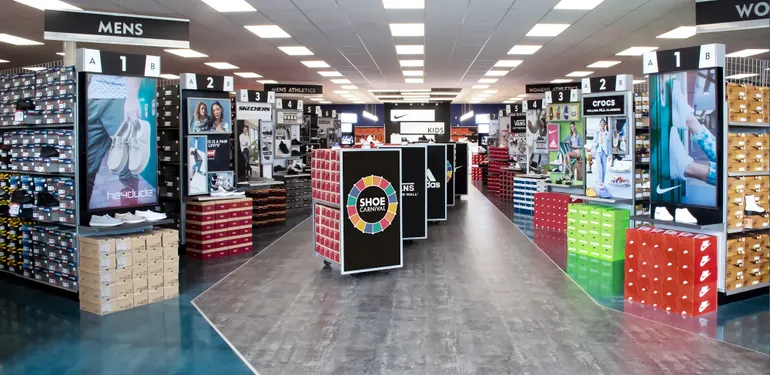
When stores were converted to the Shoe Station format, the company implemented straight-line shelving to modernize the aesthetic and streamline inventory management. However, this design choice created unexpected friction for traditional shoppers. The straight-line configuration physically blocked customers from easily seeing products located further back in the aisles. As a result, shoppers reported difficulty finding items they were looking for and expressed frustration at not being able to view the store’s broader merchandise assortment.
In response to this consumer friction, the retailer analyzed customer demographics around each rebannered location and concluded that while localized product curation is essential, the physical shopping environment must match customer expectations. Management realized that in most cases, the optimal retail formula for these specific communities actually looks like a "Shoe Carnival assortment inside a Shoe Station store," paired with a familiar layout.
To correct these structural limitations, the retailer announced plans to overhaul the layout in 74 of its rebannered stores, returning the shelving to its original angled aisle configuration. This physical reconfiguration project is scheduled for completion during the fourth quarter.
Broader Implications and Industry Analysis
The turbulent journey of Shoe Station Group serves as a case study in the perils of forcing a unified retail strategy across diverse consumer bases. Mergers, acquisitions, and rebrandings frequently promise operational synergies and streamlined marketing, but they routinely underestimate the loyalty consumers hold toward legacy regional brands and familiar store layouts.
For Shoe Carnival, the attempt to elevate its entire fleet into higher-end Shoe Station locations created a dangerous disconnect. By alienating its core, moderate-priced family demographic and introducing a confusing in-store shopping environment, the company inadvertently suppressed sales and invited margin contraction.
As interim CEO Cliff Sifford steers the organization back toward a multi-banner approach, the immediate focus remains on executing the Q4 layout retrofits and preparing for the massive banner transitions slated for early 2027. Whether these corrective measures can successfully win back disgruntled shoppers and revitalize financial growth will determine the long-term viability of the company’s dual-brand strategy in an increasingly competitive footwear market.