The Reality Gap: Why AI Shopping Assistants Are Currently Falling Short of Consumer Expectations

The rapid ascent of agentic AI—autonomous systems designed to perform tasks on behalf of users—has been heralded as the next frontier of e-commerce. From personal shopping assistants to automated procurement bots, the promise is a frictionless, hyper-personalized consumer experience. However, new empirical research indicates that the current generation of Large Language Models (LLMs) is struggling to bridge the gap between high-level reasoning and the granular, real-time demands of online retail. According to a recent study conducted by ob.session, a real-time product recommendation engine for Shopify, the gap between AI promises and delivery is not just a minor inconvenience; it is a fundamental reliability issue that threatens the nascent ecosystem of agentic commerce.
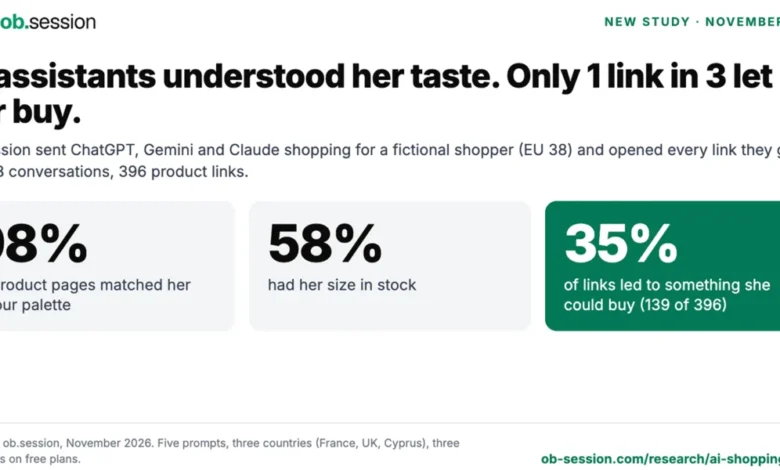
The study involved a rigorous test of the industry’s leading models—OpenAI’s ChatGPT, Google’s Gemini, and Anthropic’s Claude. By tasking these models with acting as a shopping assistant for a fictional persona, “Laura,” researchers evaluated the accuracy of over 400 product recommendations. Laura, a UK size 10 shopper, was placed in diverse geographical contexts—including France, the UK, and Cyprus—to test how well these models navigated regional stock availability, sizing conventions, and currency requirements. The results were stark: of the 400 links provided by the models, only 35% were actually in stock and available for purchase.
A Chronology of the AI Shopping Hype Cycle
To understand the current friction, one must look at the timeline of the “AI Shopping Assistant” emergence. The evolution began in earnest following the public release of GPT-4 in early 2023, which demonstrated an unprecedented ability to parse natural language queries. By mid-2023, major e-commerce platforms began integrating “conversational search” features, hoping to move beyond the rigid, keyword-based filters that have defined digital storefronts for two decades.
By late 2023, the focus shifted from simple search to “agentic” capabilities—the idea that an AI could not just find a product, but evaluate it, check its price against alternatives, and potentially initiate a purchase. However, as the ob.session research suggests, this transition has been hampered by a lack of real-time synchronization between the LLM’s training data and the dynamic, volatile environment of retail inventory management. While the models are proficient at understanding the “intent” of a shopper, they are currently ill-equipped to interface with the “truth” of a warehouse database.
The Quantitative Reality: Success Rates Across Models
The performance disparity among the top three models highlights the varying architectural approaches to web browsing and information retrieval. ChatGPT emerged as the most reliable, successfully navigating the requirements of size, location, and stock availability 45% of the time. Google’s Gemini followed with a 33% success rate, while Claude trailed at 21%.
The primary failure point across all models was not a lack of reasoning power, but a lack of live data accuracy. In 29% of cases, the product existed on the retailer’s website, but the specific size required by the shopper was sold out. This creates a “phantom inventory” scenario where the AI perceives a valid search result based on outdated or cached information, leading the user to a dead end.
This data suggests that even the most sophisticated LLMs are suffering from a latency issue. Because these models are not inherently connected to a retailer’s Enterprise Resource Planning (ERP) system in a live capacity, they are forced to rely on indexed snapshots of the web. In a retail environment where inventory can fluctuate in minutes due to high traffic or flash sales, an index that is even 24 hours old is functionally obsolete.
The Catch-22 of Retailer Visibility
Ksenia Sukhova, co-founder and CCO of ob.session, characterizes the current state of agentic commerce as a “catch-22” for retailers. The dilemma is two-fold: if retailers maintain poor or disorganized product data, AI agents will either skip them entirely—because the agent cannot confirm the availability—or, worse, they will recommend products that are out of stock, damaging the merchant’s brand reputation.
“When the information an LLM relies on is outdated, contradicts itself, or doesn’t clearly show availability, trust is lost on two sides,” Sukhova explains. “Retailers lose trust as merchants because a shopper arrives expecting a product only to find it missing. Simultaneously, the LLMs lose credibility. If a user encounters a ‘sold out’ notice three times in a row via an AI assistant, they will inevitably return to traditional search methods.”
This creates a paradox: retailers who optimize their websites for AI “readability” are more likely to be featured, but if the AI agent misinterprets the metadata, the retailer suffers the consequences of a frustrated customer. Conversely, those who do not optimize their data risk total invisibility in an era where consumers are increasingly delegating their shopping habits to autonomous agents.
Implications for the Digital Commerce Ecosystem
The implications of this research are significant for the future of digital marketing and search engine optimization (SEO). For years, retailers have focused on “Google SEO”—optimizing content to rank on a results page. The rise of agentic AI necessitates a pivot toward “AI-Ready Data.”
Structured data—the behind-the-scenes code that tells a machine what a product is, how much it costs, and whether it is in stock—is now more critical than ever. In the previous era of e-commerce, a slightly inaccurate stock status might have been a minor annoyance. In the era of agentic commerce, where an AI is making a decision on behalf of a human, inaccuracy is a terminal failure.
Experts suggest that the future of retail will depend on the development of APIs (Application Programming Interfaces) that allow LLMs to query live inventory databases directly, rather than relying on web scraping. Until this infrastructure becomes standardized, the “agentic” shopping experience will remain a fragmented, unreliable luxury rather than a mass-market utility.
Beyond the Hype: The Path Forward
The path forward for retailers involves a rigorous housecleaning of their digital architecture. To stay relevant in an AI-dominated search environment, businesses must prioritize the following:
- Real-Time Data Exposure: Ensuring that product availability, sizing, and regional shipping data are exposed via standardized, machine-readable formats.
- Schema Markup Optimization: Utilizing advanced schema markups that provide AI crawlers with definitive, non-contradictory information regarding inventory levels.
- API-First Inventory Management: Moving away from static product pages toward dynamic, API-driven inventory systems that can serve live data to third-party agents.
While the current research paints a sobering picture, it is important to contextualize these findings as part of an early-stage technological adoption cycle. The transition from “browsing for products” to “having products found for you” is a fundamental shift in consumer behavior. As models become more integrated with real-time retail backends, the accuracy rates will undoubtedly climb.
However, for the present, the lesson for both developers and retailers is clear: artificial intelligence is only as good as the data it is fed. The competitive advantage of the next decade will not go to the company with the most advanced model, but to the company that can provide the most accurate, clean, and accessible data to the machines that are shaping the future of commerce. As the industry matures, the retailers who fail to treat their data as a primary product will find themselves increasingly invisible in a landscape where the consumer is no longer doing the searching themselves.