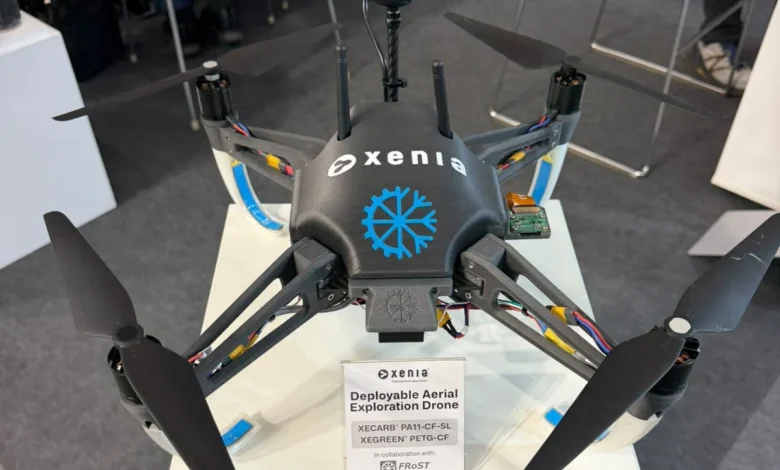
The Frankfurt Robotics Science Team (FRoST), an elite student engineering group based at the Frankfurt University of Applied Sciences, has successfully integrated advanced composite material technology into the development of Daedalus, an autonomous aerial drone designed for planetary exploration. By partnering with Italian materials innovator Xenia Materials, the student engineers have achieved a significant milestone in aerospace miniaturization, producing a fully functional drone that weighs only 1.7 kilograms. This development marks a critical advancement for the team as they prepare to compete in the prestigious European Rover Challenge (ERC), an international competition that tests the limits of robotics in simulated Martian and lunar environments.
The Challenge of Extraterrestrial Exploration
The European Rover Challenge represents one of the most rigorous testing grounds for academic robotics teams worldwide. Established to foster innovation in space exploration, the event challenges participants to design and build autonomous systems capable of traversing challenging terrain, performing scientific experiments, and conducting remote geological surveys.
Within the context of the ERC, the primary objective is to simulate a mission on a planetary surface. The FRoST team’s entry, the Eros rover, is designed for ground-level tasks. However, the introduction of the Daedalus drone serves as a force multiplier. By providing a bird’s-eye perspective, the drone allows the mission control team to map obstacles, identify mineral deposits, and maintain communication relays that might otherwise be blocked by topographical features. The engineering mandate for Daedalus was clear: it had to be light enough to be carried by the rover, yet robust enough to withstand the unpredictable winds and harsh conditions characteristic of a simulated planetary environment.
Engineering Breakthrough: Materials and Manufacturing
The structural integrity of the Daedalus drone is largely attributed to the strategic application of Xenia Materials’ advanced filament portfolio. To meet the stringent requirements of flight—where every gram of mass directly affects battery life and flight stability—the team utilized Fused Filament Fabrication (FFF) and Fused Deposition Modeling (FDM) 3D printing technologies.

For the drone’s motor arms and thermal protection spacers, the team selected Xecarb PA11-CF-SL. This material is a 100% bio-based nylon 11 filament reinforced with 15% carbon fiber. A standout feature of this material is Xenia’s proprietary "SuperLight" technology, which brings the material’s density down to a remarkably low 0.99 g/cm³. By integrating this material, the FRoST team achieved a weight reduction of more than 30% compared to traditional 3D printing filaments, without sacrificing the stiffness necessary to prevent structural vibration during high-speed flight.
The drone’s protective outer shell, or cover, required a different set of mechanical and aesthetic properties. For this, the team employed Xegreen PETG-CF, a filament composed of 100% recycled PETG reinforced with 20% carbon fiber. Beyond its environmental credentials, the carbon fiber reinforcement significantly improved the surface finish of the printed parts. In standard FDM printing, layer lines—the visible ridges created during the additive manufacturing process—can create weak points and aerodynamic drag. The Xegreen PETG-CF material allowed for a uniform finish that mitigated these issues, ensuring that the drone remained aerodynamically efficient while maintaining a professional, high-performance aesthetic.
Timeline of the Daedalus Development Cycle
The development of Daedalus followed a rigorous, multi-stage engineering timeline typical of high-level academic research projects:
- Phase I: Conceptualization (Early 2026): The FRoST team identified the need for aerial reconnaissance to improve their ERC mission profile. Initial weight budgets were set at 2.0 kg, a target that was later revised downward to 1.7 kg as material optimization strategies matured.
- Phase II: Material Selection (Mid-2026): Collaborating with Xenia Materials, the team analyzed several high-performance polymers. The focus shifted toward finding a balance between bio-based sustainability (aligned with the university’s environmental goals) and extreme structural performance.
- Phase III: Prototyping and Optimization (Q3 2026): Iterative testing of the Xecarb PA11-CF-SL motor arms was conducted. By optimizing print parameters—such as infill density and wall thickness—the team reached the 30% weight reduction milestone.
- Phase IV: Integration and Flight Testing (November 2026): The final assembly of the Daedalus drone was completed in Mussolente, Italy, and at the Frankfurt University of Applied Sciences. Flight trials confirmed that the structural rigidity was sufficient for sustained autonomous operations.
Strategic Implications of Lightweight Composites
The successful implementation of these materials underscores a growing trend in the aerospace sector: the decentralization of manufacturing. By utilizing industrial-grade 3D printing materials, student teams can now access performance metrics previously reserved for multi-million-dollar aerospace agencies.
From a technical perspective, the use of carbon-fiber-reinforced filaments is becoming the industry standard for lightweighting. According to recent aerospace industry reports, the ability to manufacture near-net-shape components using 3D printing reduces material waste by up to 90% compared to traditional CNC machining of aluminum or steel. For the FRoST team, this shift has implications beyond the ERC competition. It demonstrates that advanced composite materials, when paired with thoughtful geometric design, can solve complex mobility problems in remote or inaccessible locations.

Industry and Academic Synergy
The collaboration between Xenia Materials and the Frankfurt University of Applied Sciences serves as a case study for industry-academia partnerships. For Xenia, providing these advanced materials to a competitive university team allows them to showcase the real-world utility of their filaments under extreme, real-world testing conditions. For the students, access to these proprietary materials provides a distinct competitive advantage, enabling them to push the boundaries of their drone’s performance.
While the primary focus remains on the ERC, the technologies developed for the Daedalus project have broader potential applications. Lightweight, durable, and easily replaceable 3D-printed parts are highly desirable in sectors such as medical robotics, drone delivery services, and search-and-rescue operations. The success of the Daedalus drone highlights that the future of robotics lies in the intersection of material science, additive manufacturing, and sustainable engineering.
Looking Ahead
As the FRoST team moves closer to the upcoming European Rover Challenge, the Daedalus drone will undergo further stress testing to ensure it can survive the physical rigors of the competition’s simulated planetary terrain. The team’s focus is now on fine-tuning the drone’s autonomous navigation software, which must work in tandem with the physical structure to ensure the drone remains stable even in high-wind conditions.
The achievement of a 1.7 kg takeoff weight is not merely a quantitative victory; it is a qualitative step forward in the democratization of aerospace technology. By proving that high-performance, lightweight drones can be built by university students using accessible 3D printing technologies, the FRoST team is setting a new benchmark for what is possible in the world of competitive robotics. As global industries continue to prioritize sustainable, low-mass solutions for transport and exploration, the lessons learned from the Daedalus project are likely to resonate well beyond the confines of the ERC competition, informing future designs for everything from planetary landers to urban logistics drones.