The Thread of American Myth: Interdisciplinary Artist Nick Doyle Explores Labor, Isolation, and the Self-Made Man Through Denim and Printmaking

The intersection of material culture and national identity often serves as fertile ground for contemporary artists seeking to dissect the underlying complexities of American society. For Brooklyn-based interdisciplinary artist Nick Doyle, that exploration is anchored in a decidedly familiar textile: denim. Known primarily for his labor-intensive, large-scale denim collages that interrogate historical nostalgia, consumerism, and masculine archetypes, Doyle has expanded his artistic vocabulary into the realm of printmaking. His latest exhibition, Lonely but Free I’ll Be Found, debuted at Pace Prints’ New York gallery this fall and is slated for a prominent showcase at Art Basel Miami Beach.
This new body of work marks a significant departure from his usual sculptural wall works and immersive environments, applying graphic interpretations of everyday objects to examine deeply ingrained cultural preoccupations with risk, reward, escapism, and the enduring myth of the self-made man. Through cyanotypes, prints, and stencils executed in a monochromatic, denim-blue palette, Doyle uses the iconography of everyday life to reflect on the tensions defining modern American existence.
The Evolution of an Artistic Medium
Doyle’s trajectory toward becoming one of contemporary art’s foremost sculptors of denim was largely serendipitous. Born in Los Angeles and now based in Brooklyn, Doyle earned his Bachelor of Fine Arts in interdisciplinary arts from the San Francisco Art Institute, followed by a Master of Fine Arts in sculpture from Hunter College. His foundational training also included studies at the prestigious Skowhegan School of Painting and Sculpture, an environment known for fostering rigorous, conceptual approaches to art-making.
Despite this traditional sculptural background, Doyle’s career took a decisive turn when a neighboring fashion designer vacated a studio space, discarding a vast inventory of leftover materials. Among the discarded items was a bolt of raw denim. At the time, Doyle had been deeply immersed in historical research concerning American mythology, nostalgia, and industrial heritage. Recognizing the material’s profound historical ties to American labor, workwear, and frontier culture, he understood immediately that he had encountered a vital medium for his conceptual framework.
Since that discovery, Doyle has built a critically acclaimed career exhibiting with prominent international galleries such as Perrotin and Brussels-based Stems Gallery. His portfolio has expanded to encompass not only painting-like wall works but also large-scale, interactive installations that challenge viewers to confront the psychological undercurrents of contemporary life.
From AI Avatars to Corporate Kink: Recent Exhibitions

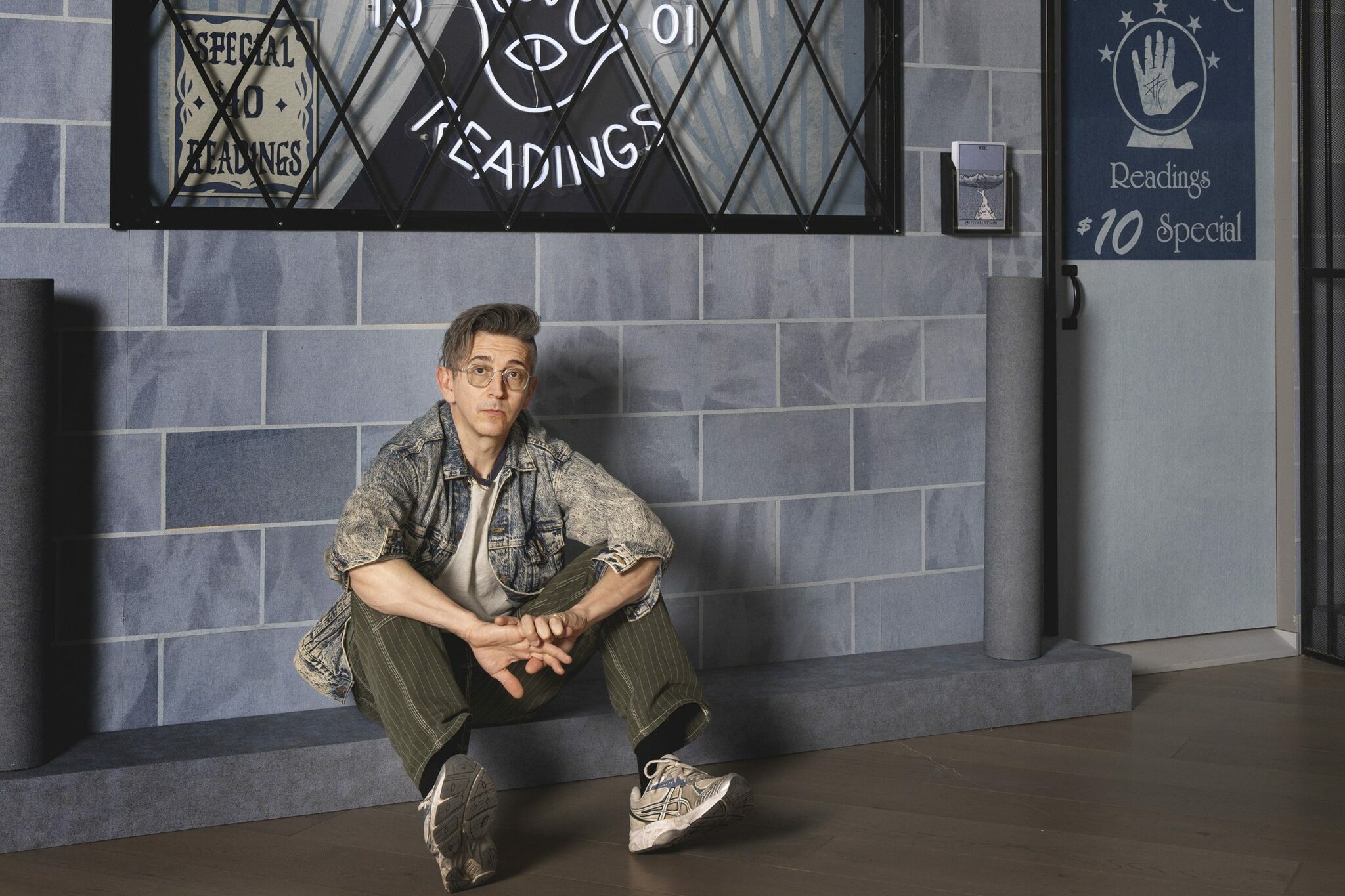
Doyle’s recent curatorial footprint demonstrates an artist unafraid of shifting mediums and conceptual boundaries. Earlier this year at Perrotin New York, Doyle presented Collective Hallucinations, an exhibition that featured wall-mounted denim collages alongside an interactive installation titled Mirror Mirror. The latter featured a denim-clad structure styled after a carnival psychic booth, complete with a sign reading “Psychic Readings $10 Special.” Inside, visitors were greeted by a sharp-witted artificial intelligence avatar named Ava—marking Doyle’s first formal incorporation of AI technology into his physical installations.
Continuing this critique of modern institutional structures, Doyle presented Human Resources at the Basel Social Club in Switzerland this past June. Constructed entirely from repurposed office cubicles and corporate furniture, the installation operated as a corporate-themed kink bar, cleverly juxtaposing the rigid power dynamics of the modern white-collar workplace with the explicit negotiation of power inherent in kink culture.
These installations, much like his sculptural collages, reflect Doyle’s ongoing interest in systemic alienation. Raised in a Quaker community, Doyle frequently points to the friction between his meditative, consensus-driven upbringing and the hyper-accelerated, consumer-driven rhythm of contemporary American life. Rather than offering an individualist critique, his work acts as a collective mirror, reflecting structural anxieties back onto the viewer.
Anatomy of an Exhibition: Lonely but Free I’ll Be Found

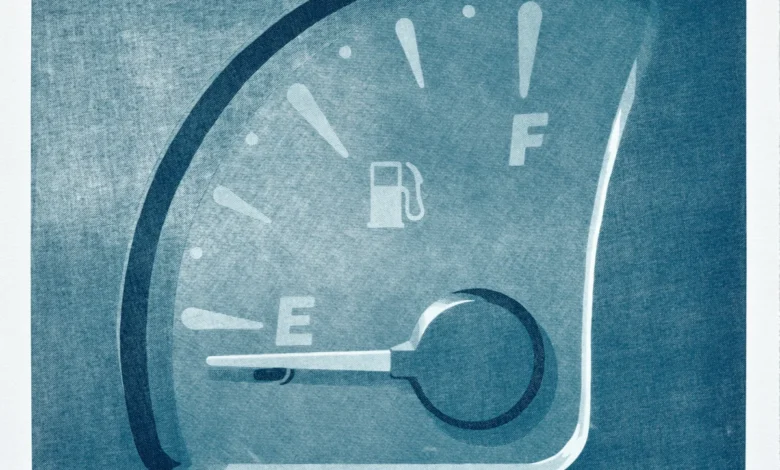
Doyle’s current exhibition with Pace Prints, Lonely but Free I’ll Be Found, distills these broad sociological inquiries into precise, evocative depictions of mundane objects. Rendered entirely in blue tones that evoke both cyanotype photography and indigo denim dye, the exhibition features subjects such as a neatly folded button-down shirt, a necktie, a lottery scratch-off ticket, an empty fuel gauge, and an industrial Coca-Cola vending machine.
The exhibition title is drawn directly from the lyrics of "Tumbling Tumbleweeds," a song famously performed by The Sons of the Pioneers, which originated as a 1930s poem by Bob Nolan chronicling the lonely journey of cowboys adrift on the open range. By pairing this nostalgic framing with stark depictions of economic precarity and consumer fatigue, Doyle interrogates the contemporary manifestation of the American dream.
The artwork titled Quick Fix (2026), for instance, presents an open carrying case containing a pair of boxing gloves, a coil of rope, a wrench, and various bar tools, including a metal shaker and a flask. The piece encapsulates themes of manual labor, coping mechanisms, and physical endurance. Similarly, The Itch (2026) depicts a lottery scratch-off ticket, highlighting the desperation and false promises associated with financial upward mobility in a volatile economy.
Conceptual Foundations: Music, Desert Landscapes, and the Suicide Belt

In discussing the conceptual underpinnings of Lonely but Free I’ll Be Found, Doyle points to three primary sources of inspiration that informed the creation of the work: Ken Burns’ acclaimed documentary series Country Music, the Neon Museum in Las Vegas, and the sociological concept of the "suicide belt."
The Influence of Country Music and Frontier Lore
Ken Burns’ documentary serves as an emotional blueprint for the exhibition, tracing the historical roots of country music alongside the broader socio-economic shifts of the United States. Doyle found inspiration in the genre’s themes of salvation, communal longing, and isolation. The romanticized archetype of the independent cowboy—once celebrated as the ultimate symbol of American autonomy—now serves in Doyle’s work as a poignant reminder of the alienation produced by radical self-reliance.
The Neon Graveyard of Las Vegas

Frequent road trips through the American Southwest exposed Doyle to the Neon Museum in Las Vegas, Nevada, where decommissioned signage from the mid-20th century is preserved in outdoor lots. Observing these retrofuturistic relics rotting away in the desert provided Doyle with a powerful visual metaphor. He notes that these objects exude a melancholic psychological aura, sitting in functionless rows much like a graveyard of discarded ambitions. In Lonely but Free I’ll Be Found, Doyle translates this feeling of obsolescence into graphic print media, directing attention not toward consumable commodities, but toward the ideological structures that produced them.
The Sociology of the Intermountain West
Perhaps the most somber thematic layer of the exhibition is informed by the research of cultural historian Matt Wray, who coined the term "suicide belt" in the early 2000s to designate the high-suicide-rate region spanning the Intermountain West, including states such as Arizona, Colorado, Idaho, Montana, Nevada, New Mexico, Oregon, Utah, and Wyoming. Wray’s research highlights how this region is disproportionately populated by aging, unattached men who face economic displacement and have high rates of gun ownership.
Doyle approaches suicide not merely as an individual tragedy, but as a broader societal symptom reflecting systemic failures within the United States. By examining the intersections of toxic masculinity, isolation, and economic despair, Doyle positions his subjects as monuments to a demographic burdened by the unattainable expectations of self-sufficiency.

Broader Implications and Cultural Impact
As Pace Prints prepares to bring a curated selection of works from Lonely but Free I’ll Be Found to Art Basel Miami Beach, the exhibition arrives at a critical juncture in contemporary discourse surrounding national identity and economic anxiety.
Art critics and cultural analysts have noted that Doyle’s transition into printmaking allows his incisive commentary to reach a broader audience without sacrificing the tactile depth that defined his sculptural output. By utilizing cyanotypes and graphic stencils, Doyle strips away the physical bulk of his previous denim assemblages, leaving behind skeletal, blueprint-like representations of Americana that feel both ghostly and urgent.
Furthermore, the timing of the exhibition—juxtaposing historical mythologies of the frontier with modern socio-economic realities—resonates strongly with contemporary political discourse regarding individual autonomy versus collective responsibility. The parallel Doyle draws between historic self-reliance and modern insular mentalities suggests that the cultural costs of the American dream are escalating.

Through Lonely but Free I’ll Be Found, Nick Doyle successfully bridges the gap between historical introspection and contemporary critique. By transforming the mundane artifacts of daily life into elegiac monuments of blue, the artist invites viewers to reckon with the fractures hidden beneath the polished surface of American culture. As these works travel to international platforms like Art Basel Miami Beach, they offer an unblinking look at the enduring myths that continue to shape the national psyche.
Related posts: