The Rise of Agentic Commerce: How AI Shopping Assistants Are Transforming Retail for Holiday 2026


The final quarter of 2026 is officially marking a watershed moment in digital retail, transitioning artificial intelligence from a passive conversational novelty into an active, transactional participant in consumer spending. Long discussed as a futuristic retail paradigm, agentic commerce has officially entered its commercial growth spurt. Major technology conglomerates, digital platforms, and traditional brick-and-mortar retail giants are rapidly deploying infrastructure designed to let software programs—commonly known as AI shopping agents—discover, compare, and ultimately purchase products on behalf of human consumers.
This shift is fundamentally altering the anatomy of the digital shopping journey. Holiday 2026 is being widely characterized by industry analysts as the first shopping season where AI shopping agents are genuinely paying their way through retailer checkouts, establishing Q4 as the true kickoff quarter for agent-led commerce. While the industry is still in its infancy regarding full-scale automation, the velocity of technological deployment and the restructuring of marketing strategies indicate a permanent transformation of the retail landscape.
The Chronology of a Shift: How We Got Here
The rapid acceleration of agentic commerce during the latter half of 2026 is the culmination of years of foundational advancements in generative artificial intelligence and large language models. For much of 2024 and 2025, AI tools were primarily utilized for product discovery, review summarization, and customer service automation. Consumers would ask chatbots for recommendations, but the final transactional step—navigating checkout pages, inputting shipping addresses, and authorizing payments—remained firmly in human hands.
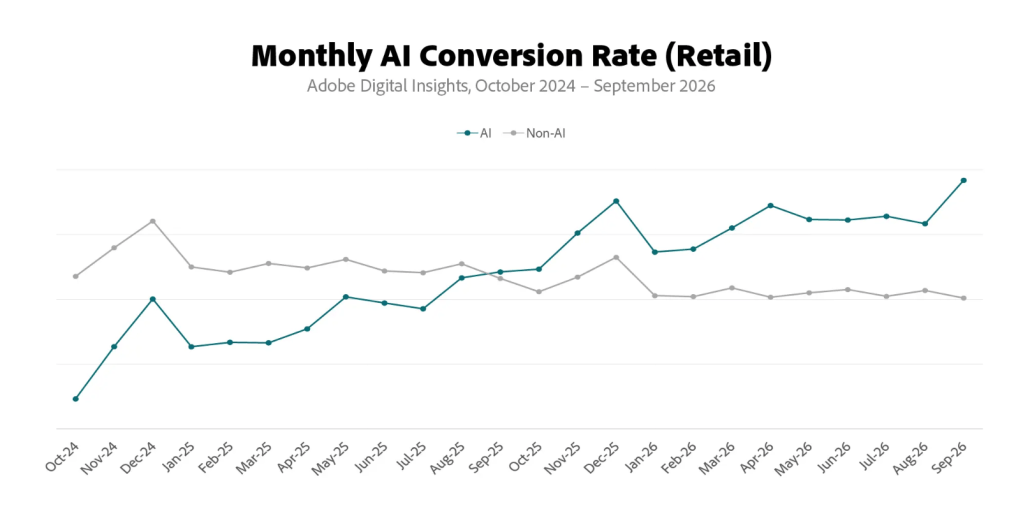
By mid-2025, early indicators showed that while AI traffic was driving substantial user engagement, conversion rates lagged behind traditional search and social channels. Data from platforms like Adobe Digital Insights revealed that as late as August 2025, traffic routed through AI tools actually converted at rates roughly 9% lower than traditional traffic sources. Consumers were exploring via AI, but buying the old-fashioned way.

The inflection point arrived in late 2026. A rapid sequence of platform rollouts shattered the barrier between conversational discovery and direct checkout. OpenAI ignited the current wave by launching the ChatGPT wallet feature, specifically engineered to streamline agent-driven purchases directly through participating retailer checkouts. Concurrently, OpenAI published a comprehensive commerce partner playbook to assist businesses in tailoring their backends for machine-to-machine transactions.
Tech giants quickly followed suit. Google initiated the rollout of its Universal Checkout Protocol (UCP)—powered checkouts in Canada through its AI Mode and Gemini interfaces. Meanwhile, traditional retail giants established their own rules of engagement. Walmart introduced customizable consumer guardrails, allowing shoppers to cap AI agent spending limits at strict thresholds of $50, $100, or $200 to mitigate financial risk. Conversely, competitive friction emerged as Amazon took defensive measures, officially blocking Meta’s Muse AI agent from crawling and interacting with its retail site, signaling a brewing turf war over customer data and digital shelf space.
Economic Projections and the Financial Trajectory
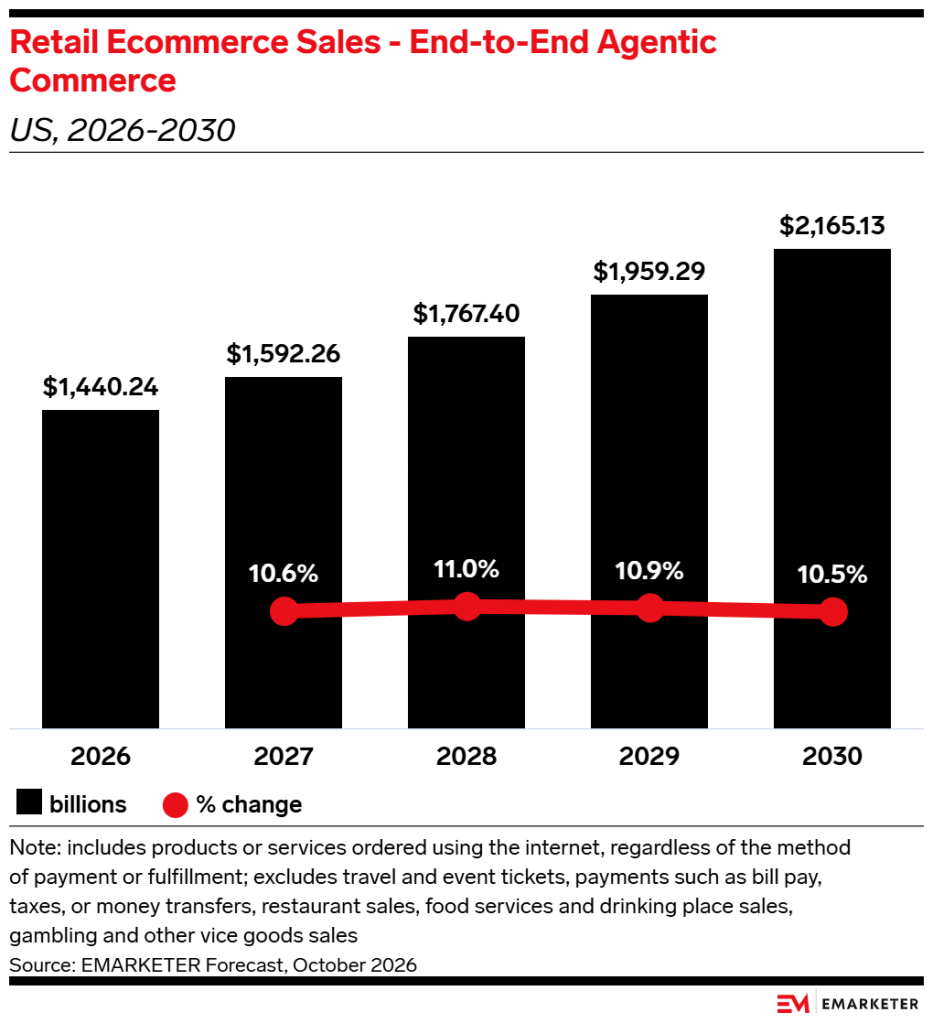
The financial commitment to agentic commerce is beginning to match the technological hype. According to market intelligence forecasts from eMarketer, U.S. retail e-commerce sales completed strictly through end-to-end agentic commerce are projected to reach $1.44 billion by the close of 2026.
This is merely the baseline of a steep upward trajectory. Industry projections indicate that this figure will climb by 10.6% to reach $1.59 billion in 2027, followed by another 11% expansion to $1.76 billion by 2028. Long-term models by digital economists project that as trust, security protocols, and machine-readable retail infrastructure mature, cumulative agentic transactions could skyrocket toward an estimated $2.17 trillion by 2030.
Consumer sentiment data reinforces the scale of this impending shift. Consumer research compiled by Bain & Company indicates that roughly one in four online shoppers (25%) plan to initiate their holiday shopping journeys this season directly on an AI platform, bypassing traditional search engines and retailer homepages entirely.
Discoverability First, Checkout Later: The Marketer’s Dilemma
For brand marketers and digital strategists, the rise of agentic commerce has necessitated a rapid pivot in digital optimization. Historically, digital marketing strategies focused heavily on human psychology, aesthetic appeal, and visual merchandising. Today, survival in the digital marketplace requires optimizing for machine interpretability.
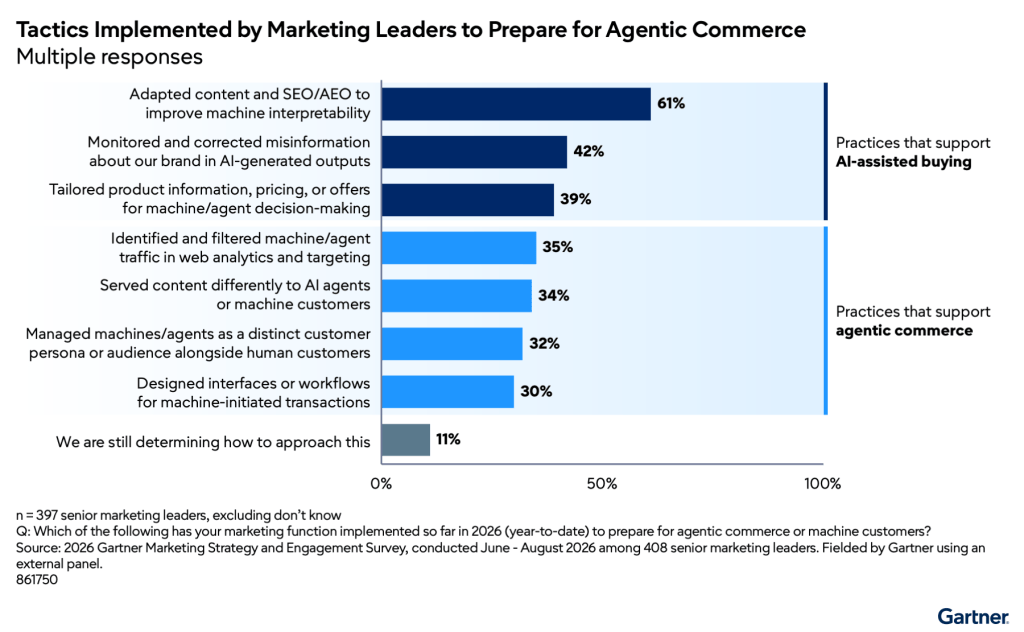
Data from Gartner’s 2026 Marketing Strategy and Engagement Survey illustrates how marketing leaders are scrambling to adapt. The survey reveals that 61% of senior marketing leaders have actively restructured their website content, search engine optimization (SEO), and newly minted artificial engine optimization (AEO) frameworks to make their brand portfolios easily digestible by algorithms.
Furthermore, 42% of surveyed marketing executives are actively monitoring and correcting algorithmic hallucinations or misinformation regarding their products in AI-generated outputs. Additionally, 39% have custom-tailored their product metadata, dynamic pricing structures, and promotional offers specifically to cater to machine and agent decision-making logic rather than human browsing habits.
However, a significant strategic disconnect remains within corporate boardrooms. While marketing departments are heavily investing in making brands discoverable to AI, far fewer have built the operational architecture required to facilitate transactions originating from software agents. Gartner’s findings indicate that only 30% of marketers have successfully designed user interfaces or backend workflows specifically built for agent-to-business transactions. Moreover, just 32% of organizations manage software agents and automated bots as a distinct, specialized audience segment operating alongside human consumers.
The Trust Deficit: Why Shoppers Aren’t Fully Handing Over the Keys
Despite the aggressive deployment of AI wallets and automated checkout protocols by technology firms, consumer psychology reveals a profound hesitation toward total automation. The convenience of autonomous shopping is currently counterbalanced by deep-seated concerns regarding financial security, privacy, and loss of control.
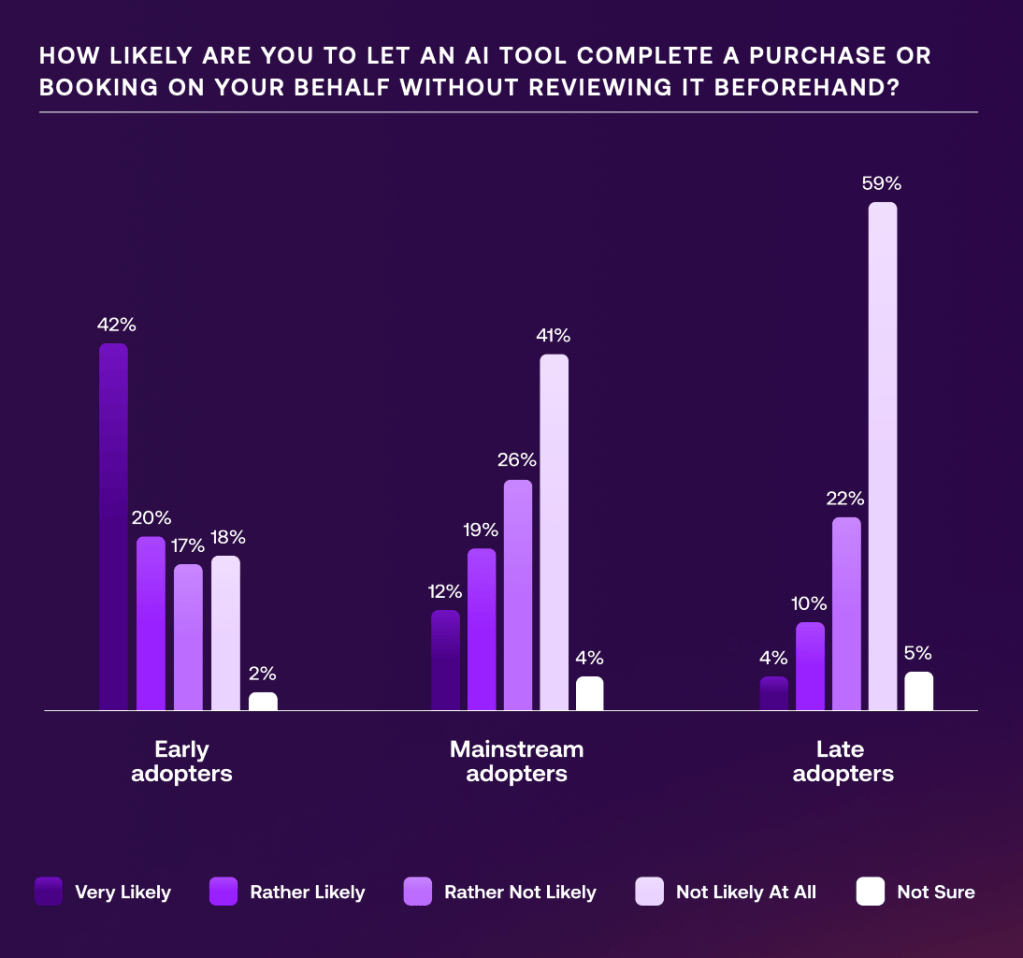
Insights from identity and access management leader Okta, detailed in their Customer Identity Trends Report 2026, expose a striking chasm in consumer trust. When surveyed about their willingness to permit an AI shopping agent to independently complete a purchase without prior manual review, only 31% of general consumers reported feeling very or rather likely to do so. Conversely, a commanding 67% stated they were unlikely to authorize unsupervised AI purchases, with 41% explicitly declaring they would never allow an agent to spend their money without direct oversight.
This hesitation, however, is not uniform across all demographics. Early adopters of artificial intelligence exhibit a radically different risk tolerance. Among tech-forward consumers, nearly two-thirds (62%) reported a willingness to let an AI agent finalize transactions autonomously, and 42% expressed a high degree of confidence in doing so.
Industry analysts note that this trust gap highlights the primary hurdle for the next phase of e-commerce evolution. The limiting factor of agentic commerce is no longer rooted in software capabilities or hardware limitations; rather, it hinges entirely on the establishment of robust trust frameworks, biometric authentication layers, and transparent liability safeguards.
The Changing Economics of Conversion and Traffic Quality
Even if everyday consumers are hesitant to grant AI total autonomy over their checking accounts, AI tools are already exerting a massive gravitational pull on where shoppers choose to spend their money. More importantly, the quality of traffic delivered by AI assistants has experienced a dramatic and unprecedented reversal of fortune.
Figures compiled by Adobe Digital Insights demonstrate that in September 2026, shoppers arriving at U.S. retail e-commerce websites via AI-driven referral tools converted at rates 90% higher than traffic originating from traditional digital channels. This represents the highest conversion efficiency Adobe has ever recorded for AI platforms, marking a stunning turnaround from August 2025, when AI-driven traffic converted at a rate 9% worse than standard traffic channels.
This high conversion rate suggests that when an AI agent successfully guides a consumer to a product page, the user’s intent is exceptionally refined. The conversational pre-qualification performed by the AI weeds out casual browsers, delivering high-intent buyers directly to the point of sale.
Broader Industry Implications: The Disruption of Digital Advertising and Retail Media
As agentic commerce matures, its ripple effects threaten to destabilize long-standing business models employed by dominant online retailers and search platforms. The traditional e-commerce playbook relies heavily on visual discovery, impulsive browsing, and paid sponsored placements designed to catch a human eye.
The financial magnitude of this traditional model is staggering. According to comprehensive market breakdowns by Enders Analysis, Amazon alone generated $68.5 billion in net sales from its proprietary online stores during the third quarter of 2026 alone. This was bolstered by an additional $46.5 billion derived from third-party seller services and $20 billion generated specifically through its expanding advertising services division.
The rise of agentic commerce directly challenges these revenue streams. When consumers delegate their product research to AI agents—whether operating through ChatGPT, Gemini, or independent retail bots—those agents are engineered to prioritize utility, objective value, specifications, and consumer reviews over paid banner ads and sponsored listings.
If shoppers increasingly rely on neutral AI agents to identify, filter, and recommend products, the entire architecture of retail media networks faces structural pressure. E-commerce giants like Amazon find themselves navigating a complex paradox: their massive fulfillment and logistics infrastructures will likely remain essential for executing physical deliveries initiated by external AI agents, yet their highly lucrative digital advertising segments face a potential erosion of value if fewer human eyes encounter paid placements on traditional web storefronts.
Looking Forward: The Road to 2030
As the retail industry navigates the 2026 holiday shopping season, agentic commerce stands at a fascinating crossroads. It is no longer a theoretical abstraction confined to science fiction or tech industry keynotes; it is a live, functioning economic reality backed by billions of dollars in projected volume.
However, the path from a $1.44 billion market this year to the projected $2.17 trillion milestone by 2030 requires overcoming steep hurdles. Retailers must balance aggressive technical integration with consumer protection, marketers must bridge the gap between AI discoverability and automated transactions, and platform operators must navigate intense corporate rivalries over data access and walled gardens.
Ultimately, Holiday 2026 will be remembered as the moment the shopping agent proved it could pay its own way—setting the stage for a decade where software algorithms become the primary gatekeepers of global consumer spending.